
Tax Planning vs Tax Preparation: Why Both Matter
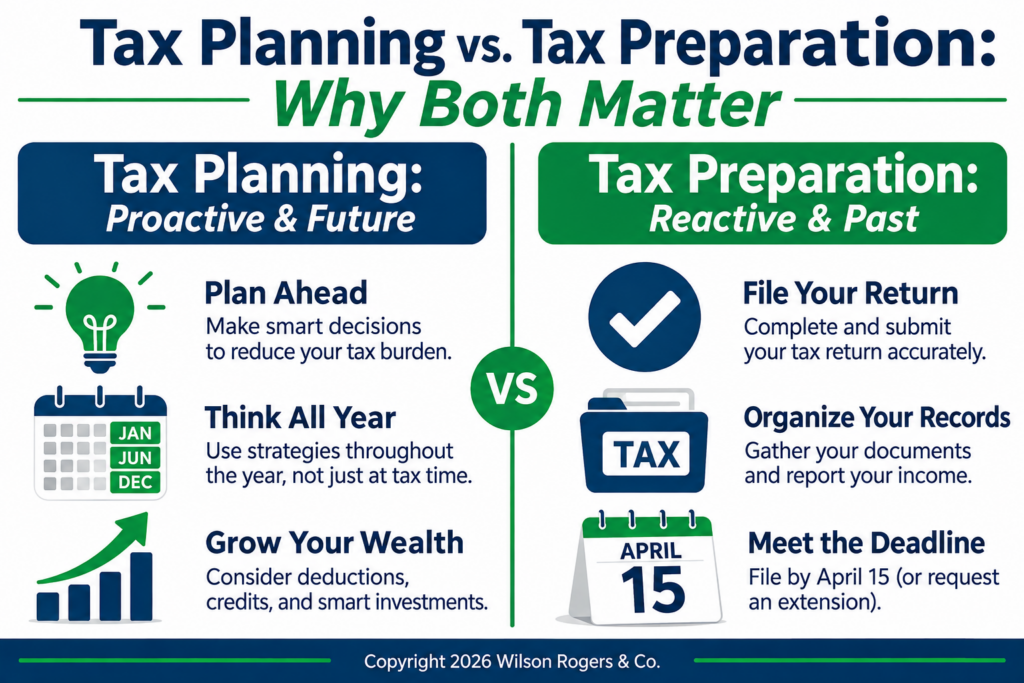
For many individuals and business owners, tax season feels like a single event that comes around once a year. Documents are gathered, information is handed off, and a return is filed. Once it’s done, attention shifts back to daily operations or personal finances until the following year. While that process is familiar, it only represents one piece of a much larger picture.
Taxes are not just a once-a-year obligation. They are the result of financial decisions made over time. That is where the distinction between tax preparation and tax planning becomes important.
Tax Preparation: Looking Backward
Tax preparation is the process most people associate with filing a return. It involves taking completed financial information from the prior year and organizing it into the proper tax reporting format. W-2 income, 1099 earnings, business profit or loss, investment activity, and eligible deductions are all compiled and reported according to IRS guidelines.
At its core, tax preparation is about accuracy and compliance. It ensures that what happened during the year is properly reflected on a tax return and submitted correctly to the IRS and state agencies.
Because of its nature, tax preparation is inherently backward-looking. By the time the return is being prepared, the financial year has already ended. The numbers are fixed, and the focus shifts to reporting rather than influencing outcomes.
Tax Planning: Looking Forward
Tax planning works in a very different way. Instead of focusing on what has already happened, it focuses on what is still within your control. It is the process of making financial decisions during the year with an awareness of how those decisions will affect future tax liability.
This can involve a wide range of considerations. For some, it may mean adjusting how and when income is received. For others, it may involve evaluating retirement contributions, managing estimated tax payments, or deciding whether a different business structure would be more efficient from a tax perspective.
Unlike tax preparation, tax planning is not about recording history. It is about influencing results before they are finalized.
Why Timing Changes Everything
The difference between planning and preparation becomes clearer when timing is considered. Take, for example, a self-employed individual earning $120,000 in net income. If no planning takes place during the year, that full amount is reported at tax time on a Schedule C, and the taxpayer is responsible for both income tax and self-employment tax on the entire profit. At that point, during tax preparation, the outcome is already set. The return reflects what happened, and there is little room for adjustment. However, if planning had been made earlier in the year, the situation might look different. The individual could have evaluated whether operating as an S corporation made sense. With proper structure and reasonable compensation, part of the income may have been treated differently for tax purposes, potentially reducing self-employment tax exposure.
The important distinction is not just the strategy itself, but when it is implemented. Once the year ends, the opportunity to influence that year’s tax outcome is largely gone.
The Limitations of Tax Preparation Alone
Many taxpayers rely solely on tax preparation without realizing what is missing in the process. While preparation ensures compliance, it does not provide the ability to adjust outcomes after the fact.
This often leads to situations where taxpayers are surprised by their tax liability, discover missed opportunities for deductions, or realize too late that certain decisions could have been structured more efficiently.
In these cases, the issue is not the quality of the tax return itself, but the absence of planning throughout the year. The return simply reflects financial decisions that have already been made.
How Planning and Preparation Work Together
Tax planning and tax preparation are not competing services. They serve different purposes and work best when used together as part of a continuous process.
Tax preparation provides clarity on where things stand after the year is complete. Tax planning uses that information to guide better decisions moving forward. One documents the outcome, while the other helps influence it.
When both are part of an ongoing approach rather than isolated events, taxpayers are better positioned to manage liability, avoid surprises, and make more informed financial decisions throughout the year.
Final Thought
Tax preparation tells the story of what already happened. Tax planning helps shape what that story will look like before it is written. When taxpayers rely on preparation alone, they are reacting to financial outcomes after they are locked in. When planning is added into the process, those outcomes become more intentional.