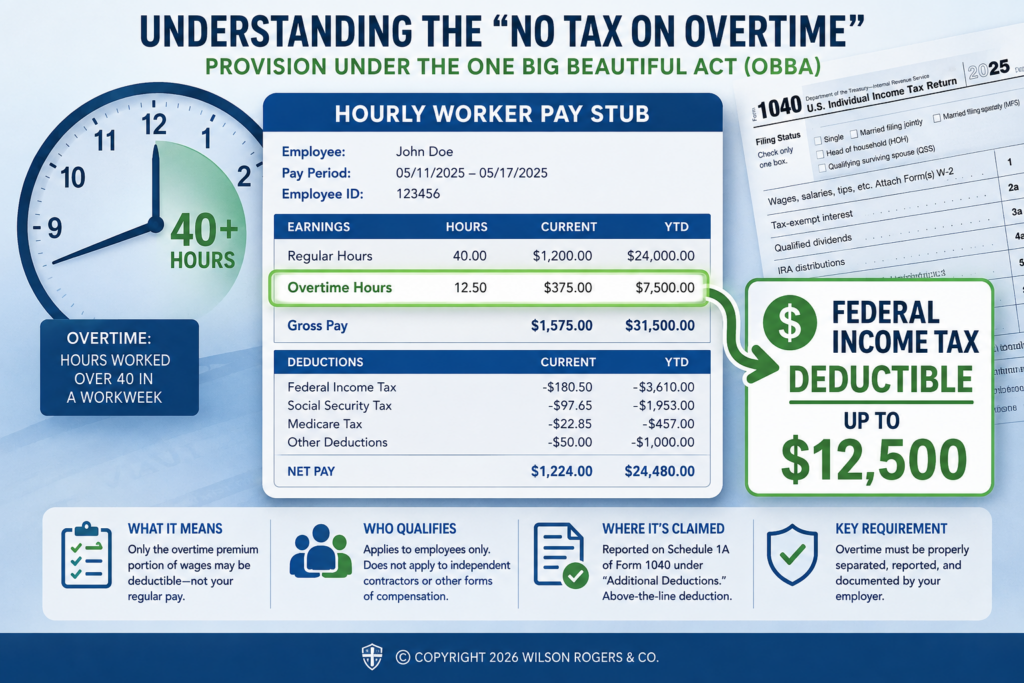
Understanding the “No Tax on Tips” Provision Under the One Big Beautiful Act (OBBA)

Tax rules continue to evolve, and every so often a provision gets a headline that sounds far simpler than what the law actually does. The “no tax on tips” provision under the One Big Beautiful Act (OBBA) is a good example of that. While the name suggests that tip income is no longer taxed, that is not what the law provides.
Tip income is still fully taxable and still must be reported. The core reporting rules have not changed. What OBBA introduces is not an exclusion from income, but a potential deduction that may reduce taxable income for certain qualifying tip earnings.
Tip Income is Still Reportable Income
The most important point to understand is that nothing about tip reporting has been removed or reduced. Employees and self-employed individuals are still required to report all tip income as part of gross income.
For employees, this continues to be reflected on Form W-2 as part of Box 1 wages. For self-employed individuals, tip income is still included in business receipts and ultimately flows through to Schedule C and Form 1040.
So despite the branding of “no tax on tips,” the income itself is still very much part of the tax system. The change occurs later in the return process, not at the reporting stage.
What the Provision Actually Does
Under OBBA, certain taxpayers may be eligible for a federal income tax deduction tied to qualified tip income. This is where the terminology often causes confusion. The law does not remove tips from taxable income. Instead, it allows a deduction against taxable income if the tips meet specific requirements. To qualify, the income must come from occupations that customarily and regularly received tips prior to December 31, 2024. This keeps the benefit focused on traditional tipped industries such as restaurant staff, bartenders, salon workers, and similar service-based roles.
Not all payments labeled as tips qualify. Service charges, mandatory gratuities, and standard wages are not included in the definition, even if they may resemble tips in practice.
How the Tax Benefit Is Applied
Even when tip income qualifies, it is still included in gross income. There is no exclusion at the wage or income reporting level.
Instead, the benefit is applied later as an adjustment to income. This means the taxpayer first reports all income normally, and then, if eligible, applies a deduction that reduces taxable income. This structure is important because it changes how the benefit is felt. Rather than removing tax from tip income entirely, it reduces overall taxable income after everything has already been reported.
Income Limits and Phase-Out Rules
The deduction is not unlimited and is subject to both a cap and income-based reductions. The maximum deduction allowed under OBBA is $25,000 per year. However, not every taxpayer will receive the full amount. The benefit begins to phase out once adjusted gross income exceeds certain thresholds. For single filers, head of household, and married filing separately, the phase-out begins at $150,000 of AGI. For married filing jointly, the threshold is $300,000. As income increases above these levels, the deduction is gradually reduced until it is fully phased out.
For self-employed taxpayers, there is also an additional limitation. The deduction cannot exceed the net profit of the business generating the tip income, which prevents the deduction from creating or increasing a loss position.
How Tip Income Is Reported Under Current Rules
Despite the introduction of this provision, the way tip income is reported has not changed. Employees still receive Form W-2 reporting their wages, including tip income in Box 1. Employers may separately track qualifying tip amounts for reporting purposes, but the overall structure remains the same. For individuals, all tip income continues to flow into Form 1040 as part of gross income. There is no separate exclusion or adjustment at the wage level. The only difference appears later in the return, where eligible taxpayers may apply the deduction.
Where the Deduction Appears on the Tax Return
The deduction is claimed on Schedule 1A of Form 1040, which is a new schedule introduced beginning in 2025 under OBBA. This schedule is used for “Other Adjustments to Income,” including several new provisions created by the legislation. In general, the deduction is based on either qualified tips reported by the employer on Form W-2 or tip income reported directly by the taxpayer on Form 4137 when applicable.
Regardless of the reporting method, the key requirement is that the income must be properly documented and traceable through official records.
Documentation and Compliance Requirements
As with most tax provisions tied to income adjustments, documentation is essential. The IRS will expect consistency between employer reporting and taxpayer reporting, and discrepancies can create issues during review. Supporting documentation may include payroll records, employer tip allocation reports, Form W-2, and Form 4137 when tips are not fully captured through payroll systems.
Accurate reporting matters not just for compliance, but also for ensuring the deduction is not disallowed due to incomplete or inconsistent records.
Final Takeaway
Despite its name, the “no tax on tips” provision does not eliminate taxation on tip income. Instead, it creates a targeted deduction that reduces taxable income for qualifying taxpayers in certain tipped occupations. The income is still reported, still tracked, and still subject to the same reporting rules as before. The difference lies in how the tax calculation is adjusted after reporting is complete.
As with most tax law changes, the real impact comes down to details, documentation, and income level. For taxpayers who rely on tip income, understanding how this provision fits into the broader return is key to avoiding confusion at tax time.