About Administrator

This author has not yet filled in any details.
So far Administrator has created 175 blog entries.

Want $40? Our 2014 Referral Program!

Every year, we listen to what our clients tell us they like and what we should change.  While we had a pretty decent referral program in the past, this year we’ve decided to go even bigger so to speak.  This year we’re offering a program where the referrer can earn $40 for each and every client they send us; an unlimited number of times.

This is open to existing clients, new clients, friends and family of the practice – essentially anyone who respects us enough to send business our way.  So no, you don’t actually have to be a “client” to earn money with us.  However, you should probably send us an email with your contact info and the name of the person you are referring so we can send you your gift at the end of the season.

So why are we doing this?  Well, all of the details can be found here, but the short answer is to reward those who think highly of us.  If you’re willing put your reputation on the line by recommending our services, we’re willing to earn it, in more ways than one!  But seriously, we want to give a little something back to those who continue to help us grow and move this practice forward.  Besides, who couldn’t use more cash these days?

By |2014-01-16T14:29:03-06:00January 16, 2014|Categories: General Ramblings|Tags: , |Comments Off on Want $40? Our 2014 Referral Program!

4 Ways People Get Into Trouble With the IRS

You don’t want to mess with the Internal Revenue Service. One small mix-up when handling your finances can cost you big.

For example, in recent years the IRS has increased its filing of levies, liens and wage garnishments. In fact, in 2010 alone, over 3 million levies were filed.

Look over this list of common ways people get into trouble with the IRS, and see if you fit any of them:

Filing too many allowances on your W4. An allowance determines how much income tax is withheld from your paycheck.  The bigger the number listed, the more pay you will take home each check.  So more is better right?

Not necessarily.  If the kids just finished college and are no longer your dependents, if you’ve just gotten married, or if you’ve just got a huge raise at work then you PROBABLY need to review your allowances. Why? We’ll if you lose dependents, that will be less of a tax reduction on your return. If you didn’t have that extra tax withheld via your checks, you may find yourself owing big time.  See this post to understand just how refunds/balances work.

Being unaware of taxes associated with the early withdrawal from certain retirement plans. If you withdraw from a retirement fund such as a 401(k) or IRA before you’re 59 1/2, you may face a 10 percent federal penalty on your investments, as well as a state penalty and an income tax on the money withdrawn.

Not paying enough taxes when self-employed. Many people who own their own businesses don’t know how much they have to pay in taxes. The tax structure for a self-employed person, what to pay, how to pay and what can be deducted, is decidedly complex, so it’s easy to become confused.  In this post, we try to shed just a little light on it.

Not paying taxes on winnings. It is necessary to report all gambling winnings, including winnings from lotteries, casinos and horse races, as income.

For people who are in trouble with the IRS, there are various programs available that can provide debt relief if a taxpayer qualifies.  If you are facing IRS debt, we can help you determine if you meet the requirements for one of these IRS programs.  Our staff includes certified public accountants and other experts that offer tax services, financial planning, small business services and other assistance. To schedule an appointment to discuss your tax situation, please call 773.239.8850.

S-Corp Home Office Deduction

Taking the home office deduction is fairly simple when you’re a self-employed individual and file Schedule C.  In those instances, you simply indicate on Form 8829 the percentage of your home that is used for work, the costs to maintain your space, and that amount will go on your Schedule C as a deduction.

If you are a member of a partnership or multimemeber LLC, then you use a similar calculation to the one listed above (see the worksheet on page 27).  However, you deduct the expenses as unreimbursed partnership expenses on Schedule E.

But what if you’re a member of a S-Corp?  Well, if you still want that home office deduction, just be prepared to do a few workarounds to get it.

25 years ago Congress enacted a law prohibiting the deduction of expenses related to the rental of a portion of one’s home to their employer.  The law was enacted in response to a Supreme Court decision [Feldman v. Commissioner].  The rental arrangement involved was viewed as an attempt to circumvent the purpose of Internal Revenue Code Section 280A, which limits deduction of expenses allocable to the business use of one’s home.

Given that office-in-the-home expenses are not allowable if the office is rented to one’s employer, an S Corporation shareholder-employee “could” deduct office-in-the-home expenses as miscellaneous itemized deductions.  But these deductions are of little or no value because of the 2% income floor imposed on Schedule A, and the add back of such deductions in computing alternative minimum taxable income.

Based on the above, the old workaround that was often used was:

  • create a rental property on Schedule E of the individuals return, and include a portion of all expenses (rent, mortgage interest, property tax, insurance, utilities, etc). You would then report an amount of income that’s equal to;
  • rent expense that you report on your S-Corp tax return. Those two amounts will offset (the rent deduction on your S-corp return and the rent income on your individual return); and you will be left with the home office deduction.

Well,  the IRS got tired of sifting through fake rental properties and instead recommends that the employee submit an expense report as part of what’s called an “accountable plan.”

So based on this guidance, here is the new way of deducting home office expenses if you are a member of a S-Corp:

  • Draft an accountable plan agreement for your company.  It will outline what expenses are eligible for reimbursement, how they will be paid, etc.  A sample plan can be found here, or you can create your own.
  • Calculate the percentage of your home that is used exclusively for business purposes.  Divide the square footage used for business by the total square footage of the home and multiply by 100.
  • Calculate the total amount of eligible reimbursable expenses (see Form 8829 above).  Multiply each amount by the percentage of business use calculated in the step above and enter the results on the expense form that you use for your accountable plan.
  • Prepare expense reports as the employee and turn them in to your company on a regular basis.  Attach receipts or other documentation to the form to substantiate them.
  • Cut the check from the business account and deposit it into your personal account. Attach a copy of the check to the form as documentation that these were paid.
  • Enter the amount of the payment into your S corporation’s records as a reimbursement for employee expenses. Post each expense claimed to the appropriate expense account so that these expenses may be deducted from the corporation’s income on its tax return.

And there you have it.  You have now created a tax-deductible business expense for the S-corp, and you don’t have to report the reimbursement as income.

Could you be paying more in taxes than you should?

As a business owner, there are some tax benefits to being structured as a S-Corp.  The biggest one (that almost everyone knows) is the potential to reduce/minimize their employment taxes.  But did you know that through some deliberate and diligent tax planning, you could be able to legally reduce your tax burden further?

If your business does $100K (or more) in revenue, you would be a perfect candidate for our S-Corp Tax Reduction Analysis.  This analysis (a package valued at $1097, but $345 to you for a limited time), includes the following:

  • One hour investigative session to understand your business operations and potential tax levers
  • Review of the past 3 years of filed Form 1120S tax returns to unearth potentially missed deductions or tax savings
  • Formulation of potential tax strategies that if implemented could reduce the underlying tax liability
  • Comprehensive report indicating findings, tax strategies and steps to implement
  • Complementary copy of Jared’s book How to Slash Your Taxes Legally and Ethically

Furthermore, this analysis is guaranteed by our 100% ironclad money back guarantee.  If we can’t find any tax savings that equal or exceed the cost of the analysis, we’ll refund your money, no questions asked!

To claim your analysis, simply email us via the address in the footer on this page or give our office a call at 773-239-8850.  We only have capacity to perform so many of these analysis per month so get yours NOW.  We look forward to working with you!

5 Quick Year End Tax Tips

So 2013 is ending in about 3 days and here you are wondering what you can do to cut your tax bill.  Well, while most of your options are just about gone, here are 5 quick things to consider:

Do A Test Run of Your Tax Return
If possible, why not do a quick test run of your return?  The year is almost done so you should have most of the information you need to come up with a projection.  Sure, some of the numbers will need to be estimated, but the end result should yield a pretty good picture.  With that picture in hand, you will know what moves you can or need to make before year’s end.

Pull Expenses Into 2013
Both individual and business returns tend to be prepared on a cash basis.  Thus, if you can spend the money in 2013, you will get it to count on your return.  Have some medical purchases (e.g. glasses, contacts, etc) that you were planning to make in January?  Move them into December and they’ll be deductible on this years tax return.  The same is true for that mortgage payment of yours.  If the bank cashes the check in December, the mortgage interest will increase your deduction for this year.

Shift Income into 2014
Are you a self employed business person?  Do you operate on a cash basis?  Well, if you want to reduce your taxable income for 2013, why not consider billing your customers late or giving them a little grace period to pay so that the revenue hits your desk in 2014.

Make Those Last Minute Retirement Contributions
Do you have a company 401(K) account but haven’t contributed the Federal maximum of $17,500?  Well, each dollar you contribute reduces your taxable income.  Already received your last paycheck?  Not to worry, you can still make a contribution to your IRA AND if you meet certain income limitations, you can shave a little off your tax bill.  If you are self employed, you can make contributions to SEP and SIMPLE plans to receive a tax benefit on your return.

Give To Charity
Were you considering making a donation next year to a certain charitable organization?  If so, consider making them in 2013 and you can reduce your taxable income.  Have some items in your house that are taking up space?  Why not give them to the Salvation Army, Goodwill or your other local charitable organization?  You’ll be able to deduct the fair market value of the goods on your tax return and help out someone in need.  Just make sure you follow these tips to get the most out of your donation.

By |2013-12-29T11:45:52-06:00December 29, 2013|Categories: Tax Talk|Tags: , , , , |Comments Off on 5 Quick Year End Tax Tips

Can You Stop The IRS From Garnishing Your Wages?

wage-garnishment-267x300-1311595100

Sometimes, no matter how careful you are about filing your taxes and paying what you owe, the time may come when you have a bill that you can’t pay.   Like all creditors, the Internal Revenue Service will try to collect what you owe using several different means.  One of those methods is via a wage garnishment.

Employers are prohibited from letting you go because of a wage garnishment issue, a protection extended under the Consumer Credit Protection Act.  However, you get only one “get out of garnishment jail free card.” A second garnishment isn’t protected by Uncle Sam, and an employer who views an employee with a second garnishment as a mark on his or her character has every right to fire them.

What is Wage Garnishment?

Simply put, a wage garnishment is when the IRS locates a debtor’s employer and takes their wages during each pay period until the debt is paid in full.  A wage garnishment can be used to collect a debt that you owe due to a late filing.  It can also be used when you file your return correctly but do not pay the full balance of your debt.

A wage garnishment is most commonly levied by the IRS or via a court ruling.  To implement the garnishment, the IRS obtains a judgment and sends it to the debtor’s employer.  The employer is then required to withhold a certain amount of the individual’s paycheck each pay period and send it to the IRS until the debt has been fully paid.  Depending on state laws, a garnishment may take anywhere from 30 percent to 70 percent of your paycheck to cover your unpaid debts.

Furthermore, the IRS is particularly tough; it can garnish both your income and, if you’re retired and collecting government benefits, can take your Social Security checks, too.  The levy usually isn’t lifted until the debt is paid off in full.  However, you do have some options, though, as outlined by the IRS.

Stopping A Wage Garnishment

Pay off the debt in full.  Once that’s done, the garnishment is automatically lifted.  This is the quickest and least painful way to get the IRS off your back.

Offer a lower bulk payment as compromise.  If you can negotiate a “payoff” sum with the IRS, you can also avoid a wage garnishment.  This one’s tricky though, and you’re better off checking in with a tax professional before you climb into the ring with the IRS.

Ask the IRS for a payment plan.  Uncle Sam may be willing to negotiate regular monthly payments to erase your debts and avoid the need to garnish your wages at all.  However, just note that this is typically only granted if you demonstrate that the levy is causing you financial hardship.  Thus, if you are receiving notices of tax debt owed, but have yet to have your wages garnished, it’s best to try and set up a payment plan BEFORE this IRS begins garnishments.  Once the garnishment is in place, the IRS has little impetus (other than the hardship situation) to revert to a payment plan if it’s collecting money from you.

Quit your job and dodge the IRS for a while.  If you quit your job, it will probably take the IRS a few months to track you down at your new job.  They won’t like it, but at least your wages won’t be garnished in your new job (for the short term, anyway).  That might buy you some time to come up with the money to settle your debt.

File for bankruptcy.  This option should not be used lightly, but if it’s “last resort” time, bankruptcy can at least help you avoid wage garnishment, or have it released if the garnishment is already in place.

Don’t create a garnishment to begin with.   The best way to avoid a wage garnishment may be old-fashioned, but it works all the time.  Pay your bills on time, save some money for emergencies and spend less than you earn.  Do that and neither your employer nor the IRS will be dogging you about wage garnishments ever again.


Milestones – Our 100th Post

To know where you are going, you must know where you've been.

To know where you are going, you must know where you've been.

Funny how time flies.  Two years ago we were just a few weeks away from opening up the doors to our Beverly retail office.  In this, our 100th post, we thought it would be appropriate to reflect a little.

When we created our blog, we set one simple goal for it; create one post per week with content we believed would be relevant to our customers as well as general taxpayers.  During that time we’ve gone through two tax seasons, refreshed our website, increased our client base as well as a host of other things.  The point you may ask?  Well, none of this would be possible without milestones.

Milestones serve to inform us of how far we are in our journey and how much further we have to go.  In the short two years of opening our office, we’ve come quite a way from our beginnings.  Yet, we still have a long way to go to our self prescribed destination.

With that said, as we prepare to enter into a new year (which many will mark with New Year’s Resolutions), we urge all of you to set goals for yourself along with milestones.  That way, when you’re questioning whether you should continue on your journey (or if you have the strength to) you’ll have a pretty clear answer to help you in your decision.

Now back to getting ready for our 3rd tax season…

By |2013-12-22T10:15:11-06:00December 22, 2013|Categories: General Ramblings|Tags: , , |Comments Off on Milestones – Our 100th Post

My View: The Two Biggest Keys To Success

When you advise aspiring and fledgling business owners, one question that routinely comes up is what it takes to be successful.  While it takes many ingredients to achieve success, there are two that are key in my opinion.

Persistency

Back in High School I tried out and made the football team.  In reality it wasn’t that hard as they pretty much took anyone who tried out.  But the real challenge was getting to play.  Most of the playing time (a.k.a. “tick”) was given to starters and second string players.  Me?  Oh, I was just a guy who was on the team; by most standards I was just your typical benchwarmer.  But just like everyone else, I earned my “letter” for each year I was on the team.  And just like everyone else, I sported my letters on my letterman’s jacket.  To the girl at the bus stop, I looked just like all the other “jocks” when we got off the bus at her stop!

Win the battle, show your medal, we're loyal to you old pal!

Win the battle, show your medal, we're loyal to you old pal!

The point of this story is what?  Quite simply, persistency pays off.  I could/should have quit numerous times during the years I played football.  The total amount of tick I got was probably the equivalent of a first half, but was spread across three years.  Yet I didn’t give up.  I never succumbed to the pressure to stop going to two-a-days.  I never let the ridicule of “star” players deter me from marching on.  But more importantly, I never let myself disappoint the one person who really mattered; me.

If you want to be successful, you have to sometimes have the fight of a dog in you.  When everything is pointing to stopping, you have to tell yourself that success may be just around the corner.  And if you can be persistent?  You might just wind up with a successful business like all those other entrepreneurs who started their business just like you did; one day at a time.

Consistency         

Some of the greatest people have achieved their success not because of special talents or intellect, but because they consistently plod along.  Whatever goals you’re trying to reach; they aren’t just going to happen.  You have to actually/consistently be working on them.

Here is a case in point.  When you are wooing someone, you go through the effort of being consistent.  You will routinely call them, see them, take them on dates, tell them they are special, compliment them, etc.  But what happens once you’ve won their heart?  Those consistent things start to fade by the wayside.  Why?  Primarily because you achieved you goal; getting them to become your boyfriend, girlfriend or spouse!

The moral of the story is that you achieve your goals by consistently doing the necessary work.  If you walk a few steps each and every day of the year, after a year you will have walked several miles.

By |2013-12-07T20:39:13-06:00December 7, 2013|Categories: Who's The Boss?|Tags: , , , , |Comments Off on My View: The Two Biggest Keys To Success

20 Things I’m Thankful For

Around this time of year, I often find myself reflecting on life. What has happened this past year, where I want to go next year and how I fit into the world.  This often happens when I am on the bike (as all you have time to do is ride and think), but this year I feel compelled to share what swirls around this old noggin with you.

If you’ve known me for any amount of time, you know that I “try” to see the good in things.  Despite reality, I try to “assume positive intent” of others and their actions.  I attempt to take nothing for granted and show appreciation for all that I have in life.  While I didn’t grow up in the lap of luxury, our family didn’t struggle either.   So with that, as I sit here on Thanksgiving, I wanted to share just a small fraction of the things I am thankful for.

Life  People take life for granted; the frailty, the certainty that it will one day end, the marvel of breathing without conscious thought.  To that end, life is an extremely precious gift that can be taken away before one’s had the opportunity to fully experience it.  With that, I am grateful for each day that I have walked on this Earth. 

My Immediate Family  The world can be a cruel place.  Sometimes, you feel as if you are standing alone and no one gives one iota about you.  But then there is your family. To my mom, dad and sister, I am so fortunate to have had them (and still do) in my life. 

The Rogers Side of the Family

The Rogers Side of the Family

My Extended Family  When you marry your spouse, you marry into their family.  If you’re lucky, it’s like gaining a whole new set of friends.  To all of those new friends (okay, not so new as I’ve been married 7 years now), I am fortunate to call you part of my family. 

The Wilson Side of The Family

The Wilson Side of The Family

My Wife I could write a book about this woman.  When you’re searching for a person to share your hopes, passions, dreams and life with, you can only hope that you’ll meet a person who meets a fraction of what you are looking for.  I was lucky enough to find someone who vastly exceeded them.  Aaronita is my rock and quite possibly the strongest woman I know besides my mother.  To that end, I wouldn’t be able to do or attempt half of what I do without her support.  So to you babe, I am extremely thankful that I had the opportunity to meet you and for me to be a part of your life. 

The Love of My Life

The Love of My Life

My Daughter  She is my love and my life was forever changed on that August 15, 2009.  She makes me strive to be a better person so that I can be the father that she deserves.  Kiddo, Dada loves you! 

The Light Of My Life

The Light Of My Life

Love  The simple act of being kind to a fellow human being is sometimes all it takes to help that person make it through a difficult situation.  I am fortunate for all the love that people have shared with me. 

My Upbringing  I grew up in a loving household with two parents that cared and a sister with whom I could share my grief with.  Not everyone has/had this in their life.  I’m thankful that I did. 

My Education  I didn’t go to the fanciest schools.  My parents did the best for me with what they had.  Each one of those schools I attended taught me something; whether it was book knowledge or life lessons.  Whether it was St. Thomas the Apostle, De La Salle, Truman State University or DePaul University, I value all the opportunity I was given.

Opportunity  What is the difference between someone who lives in Beverly Hills, the barrio, the ghetto, and Kenya?  Nothing.  But what determines how their life unfolds is intrinsically tied to the opportunities they are presented with.  Not everyone is dealt the same deck of cards.  I am happy for the one I got and the hand I’ve been able to play. 

My Corporate Career  I’ve worked with lots of people in various companies over the years.  Each one of them taught me something which made me into what I am currently.  I’m fortunate for all that I was able to experience. 

My Company  It evokes a certain feeling of pride every time I see our company’s name.  To know that it’s something that I helped create, something that serves a purpose bigger than myself, something that helps others in this world; that makes me feel proud and honored. 

Our Clients Without their trust, confidence and patronage, we wouldn’t have a company at all.  So to all of you, thank you from the bottom of my heart.

Nature  This world is a beautiful place filled with wonderful people, places, animals and other things.  I try to do my part to not destroy it and preserve it so it’s around for Pilar to enjoy.  But that aside, I am lucky to have seen some of the many sights that our amazing planet has to offer.  I can only hope that I get to see/enjoy much more in the future.

Me and Mother Nature Starting The Day

Me and Mother Nature Starting The Day

Health  Things could always be worse.  Be grateful for what you have because one day, health will fail us all.

Busted Up As Pilar Would Say

Busted Up As Pilar Would Say

Friends  I don’t keep a large circle of friends; just a few close ones.  Blame the loner in this Aquarius!  But I am extremely grateful for everyone that I have in my life, no matter how large or small the extent.

Support  It makes me smile when people say that they are “self made” or that they “did it all on their own.”  While that is somewhat true, we’ve all received an extended hand at one point or another.  To anyone who has ever helped me (like the good Samaritan who called the ambulance when I crashed and knocked myself out on the bike path), I am appreciative of you.

The United States  Sometimes this country is like the drunk Uncle in your family.  You love them, but sometimes they drive you crazy.  In the end, this county is still one where one can attempt to achieve their dreams and live a life that others in this world cannot.  Thus, I am thankful to call this place home.

God  You don’t have to be religious to believe in a higher power; I’ll be the first to admit that I’m not overly religious.  Yet I do believe that I’ve been blessed as all my “chuch folk” would say (no that is not a typo).  God, Yahweh, Buddha, Muhammad, The Universe (or whatever you want to call it) and I have a relationship.  I am thankful for that.

The Necessities  I have a roof over my head, clothes on my back and food in my belly.  Tyler Durden said it best with this statement: “Advertising has us chasing cars and clothes, working jobs we hate so we can buy s@&! we don’t need.”  In the end, I am happy for what I have because it’s all that I really need (and then some). 

To Be Employed  In these trying times, people who have had their entire existence defined by where/who they work for are struggling to cope with extended periods of unemployment.  To all of you, keep up the good fight and if opportunity doesn’t knock, build a door and then kick that joker in!

By |2013-11-28T14:35:56-06:00November 28, 2013|Categories: Who's The Boss?|Tags: , , |Comments Off on 20 Things I’m Thankful For

Understanding The 1031 Exchange

Most real estate investors have at least heard of the 1031 exchange, but very few have actually completed such a transaction.  The 1031 exchange is a powerful tool to have in your creative real estate arsenal, as it allows you to dispose of one property and acquire another without paying capital gains tax on the property you are disposing of.

However, a 1031 exchange requires careful attention to the requirements, particularly as they relate to timing, in order to avoid potential ghoulish dealings with the IRS.

To start with, it is important to understand exactly what a 1031 exchange is.  Named after the section of the Internal Revenue Code under which it resides, a 1031 exchange is the swap of one asset for another similar asset.  In other words, in order to take advantage of this tax section, the type of property swapped must be of a similar “nature or character.” For example, livestock of different genders are not considered like-kind property.

Fortunately, this is not much of an issue with real estate, as the code allows for the exchange of any real property for any other real property.  The property (generally) must be a business or investment asset, meaning the property generates revenue or helps in generating revenue.  Typically, these properties will be warehouses, offices or rental homes.  Primary residences and other property that do not generate regular income do not qualify, such as a second home or vacation home.

Properties located inside and outside the country cannot be exchanged for each other.  Also, real property cannot be exchanged for personal property, such as a house for farm equipment.  Lastly, personal residences are not eligible for like-kind exchanges; the property must have been an investment or business property to qualify.

One of the nicest features of the rule is that the properties do not have to be of similar “grade or quality.” In other words, it’s perfectly legitimate to exchange a house in much need of repairs for a property that is in pristine condition.  The like-kind exchange is an ideal vehicle for trading up properties without paying capital gains taxes.

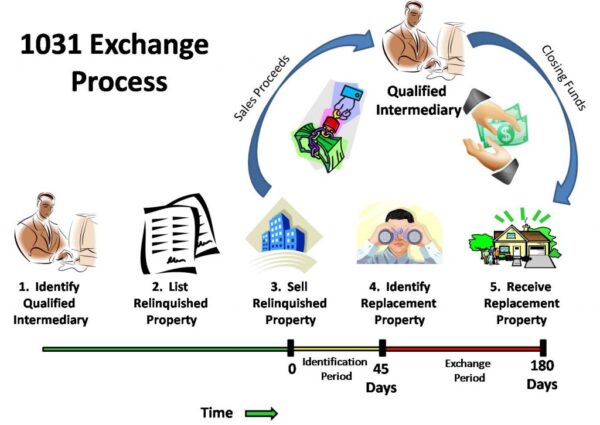
Timing is a key element to a successful 1031 exchange.  In order to qualify for the capital gains deferral, the decision to treat a property sale as part of a 1031 exchange needs to be made before the closing date of the sale of that property.  Then, the seller must identify the property to be acquired in the exchange within 45 days of the closing date of the sold property.  The new property must then be acquired within 180 days of the date that the prior property was sold.

The 1031 Exchange Explained Visually

When it comes to identifying the replacement property, there are some interesting rules, and you can pick which rule you want to follow.  The property needs to be of equal or greater value, but you can select multiple properties as potential properties to buy, subject to the following rules:

1.  You can select up to three distinct properties as possible replacement properties for the exchange, regardless of their value, OR…

2.  You can select any number of properties, as long as their total fair market value does not exceed double the value of the property you sold, OR…

3.  You can select any number of potential properties to buy, as long as the fair market value of the property you eventually close on within the 180 day window is at least 95% of the value of the property you sold.

In order to protect the “integrity” of the like-kind exchange, the IRS requires that you use a qualified intermediary in order to complete the transaction and qualify for the capital gains exclusion.  The qualified intermediary escrows the proceeds from the sale of the first property, and ensures that the funds are only used to acquire a like-kind property.

The qualified intermediary works with your title company, escrow company, or closing attorney to facilitate the transaction.  The key element of this part of the transaction is to ensure that you never actually obtain receipt of the funds from the property sold, and there is no record of it passing through your own personal accounts.

Normally when an investment property is sold, you must recapture the sum total of the depreciation you have claimed on the property.  In other words, your taxable capital gains include not only the actual appreciation in the property’s value, but also the amount that you deducted as depreciation over the time you owned.

A beautiful benefit of the 1031 exchange is that there is no depreciation recapture required.  Instead, the accumulated depreciation in the old property affects your basis in the new property you are buying in the exchange.

Since the purpose of the like-kind exchange is to avoid paying capital gains tax on appreciation of properties, there is no benefit to using a 1031 exchange on a property on which you have a loss.  By selling a property for a loss, a portion of that loss becomes deductible.  The 1031 exchange rules do not recognize losses as an adjustment to the basis in the newly acquired property, so there is no benefit in using this vehicle for that purpose.

Our hope is that this article has provided you with enough information to make the decision of when to use the 1031 exchange rules to your benefit.  As with all things, however, be sure to consult with a licensed tax professional for advice regarding your specific transaction, and remember that you must use a Qualified Intermediary in order to complete the transaction.

Are you are thinking of disposing of your property and have questions?  Why not give us a call?  We are here to help, and only a phone call away!

By |2024-08-26T15:06:54-06:00November 25, 2013|Categories: Tax Talk|Tags: , , , , , |Comments Off on Understanding The 1031 Exchange

How to Obtain 501(c)(3) Tax-Exempt Status

Donate

During the course of an average year, we often get asked if we help clients set up nonprofit organizations.  We also get asked how much it cost; to which we often respond, it depends.  Why you may ask?  Well, depending on the activities that your organization will conduct, it changes the amount of detail that you must provide in the application.  In this post, we’ll provide you with a general overview of how to go about obtaining tax exempt status.

Obtaining Tax-Exempt or 501(c)(3) Status
Most of the real benefits of being a nonprofit stem from your 501(c)(3) tax-exempt status.  These include, but are not limited to the tax-deductibility of donations, access to grant money, and income and property tax exemptions.  To apply for tax-exempt status, you must complete IRS Form 1023Application for Recognition of Exemption Under Section 501(c)(3) of the Internal Revenue Code.  Completing this form can be a daunting task because of the legal and tax technicalities you’ll need to understand.   Thus, we suggest consulting with a CPA, attorney or other professional who is experienced in preparing this form.

When to File For 501(c)(3) Status
To get the most out of your tax-exempt status, you’ll want to file your Form 1023 within 27 months of the date you incorporate.  If you file within this time frame, your nonprofit’s tax exemption takes effect on the date you filed your articles of incorporation.  Thus, all donations received from the point of incorporation onward will be tax deductible.  If you file later than this and can’t show “reasonable cause” for your delay (i.e. convince the IRS that your tardiness was understandable and excusable), your group’s tax-exempt status will begin as of the postmark date on its IRS Form 1023 application.

How to Prepare Your Tax Exemption Application
Form 1023 is divided into 11 parts.  Illustrated below is a brief overview of each of the 11 parts so you can familiarize yourself with the type of questions you’ll be asked to address.

Identification of Applicant  This section tells the IRS about your organization.  It asks for basic information like the name of your nonprofit corporation, contact information, and when you filed your articles of incorporation.  Your nonprofit must have a federal employer identification number (EIN) prior to applying for 501(c)(3) tax exemption, even if it doesn’t have employees.  Furthermore, if your organization held an EIN prior to incorporation, you must obtain a new one for the nonprofit.

Organizational Structure  This section requires that you attach a copy of your articles of incorporation and your bylaws.

Required Provisions in Your Organizing Document There are certain clauses that you must have in your articles of incorporation in order to get your 501(c)(3) exemption:

  • A clause stating that your corporation was formed for a recognized 501(c)(3) tax-exempt purpose (e.g., charitable, religious, scientific, literary, and/or educational)
  • A clause stating that that any assets of the nonprofit that remain after the entity dissolves will be distributed to another 501(c)(3) tax-exempt nonprofit – or to a federal, state, or local government for a public purpose

In this section, you state where these clauses can be found in your articles (by page, article, and paragraph).

Narrative Description of Your Activities Here you provide a detailed, narrative description of all of your organization’s activities (past, present, and future) in their order of importance (i.e. in order of the amount of time and resources devoted to each activity).  For each activity, explain

  • the activity itself, how it furthers an exempt purpose of your organization, and the percentage of time your group will devote to it
  • when it was begun (or when it will)
  • where and by whom it will be conducted
  • how it will be funded (the financial information or projections you provide later in your application should be consistent with the funding methods or mechanisms you mention here).

Compensation and Financial Arrangements  The purpose of this section is to prevent people from creating and operating a nonprofit for the sole benefit of its founders, insiders, or major contributors.  You’ll need to give information about all proposed compensation to, and financial arrangements with initial directors, initial officers, trustees, etc.

Members and Others That Receive Benefits From the Nonprofit  If your nonprofit will provide goods or services as part of its exempt-purpose activities, you must report this on Form 1023.  The IRS wants to ensure that your nonprofit is set up to provide goods and services to all members of the public — or at least a segment of the public that is not limited to particular individuals.

Your History If your nonprofit is a “successor” to an incorporated or preexisting organization the IRS wants to know this.  Your nonprofit is most likely a successor organization if it has:

  • taken over the activities of a prior organization
  • taken over 25% or more of the assets of a preexisting nonprofit
  • been legally converted from the previous association to a nonprofit

Details on Your Specific Activities This part asks about certain types of activities, such as political activity and fundraising, that the IRS scrutinizes closely.  For example:

  • 501(c)(3) nonprofit organizations may not participate in political campaigns
  • Certain types of fundraising are restricted, including bingo and gaming activities, fundraising for other nonprofits, or using a professional fundraiser

Financial Data All groups seeking 501(c)(3) exempt status must provide a statement of revenues and expenses and a balance sheet.  An organization that has been in existence for five years or more must provide financial data for its most recent five years.  Other groups must provide financial data for each year they have been in existence and good faith estimates for future years for a total of three or four years, depending on how long the organization has been in existence.

Public Charity or Private Foundation This section relates to your nonprofit’s classification as a public charity or private foundation.  Public charities, which include churches, schools, hospitals, and a number of other groups derive most of their support from the public or receive most of their revenue from activities related to tax-exempt purposes.  Most groups want to be classified as a public charity because private foundations are subject to strict operating rules and regulations.

Fee Information You must pay a fee when you submit your Form 1023 application.  Check the IRS website for user fees that vary depending on your nonprofit’s gross receipts.
 

By |2013-11-14T11:20:27-06:00November 14, 2013|Categories: Tax Talk|Tags: , , , , , |Comments Off on How to Obtain 501(c)(3) Tax-Exempt Status
Go to Top