
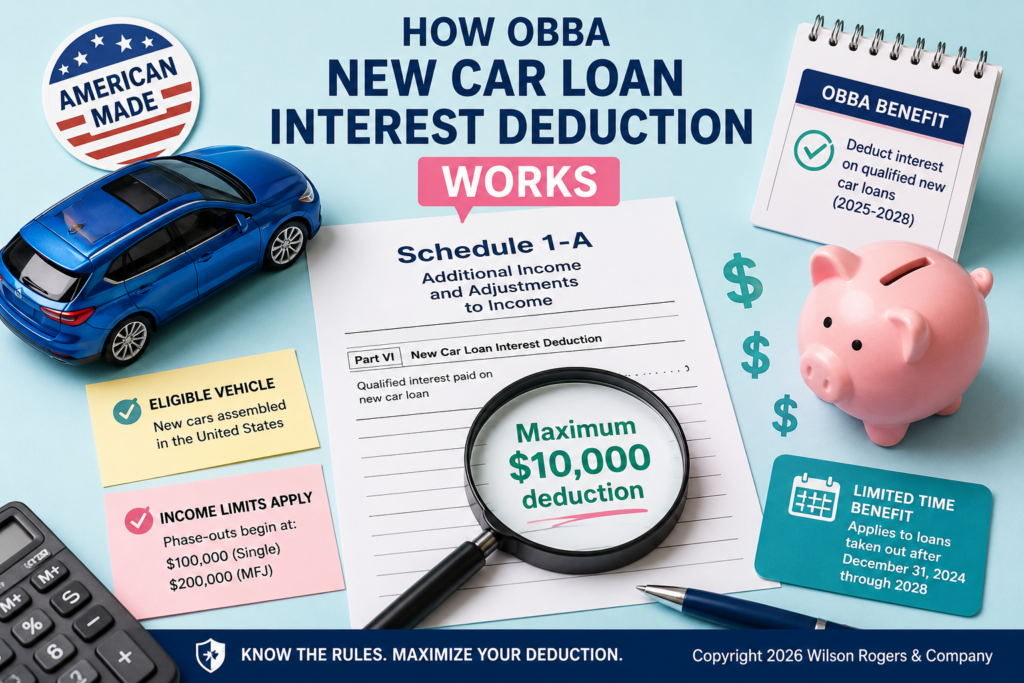
Understanding the New Car Loan Interest Deduction Under the OBBA
The One Big Beautiful Act (OBBA) introduces a new deduction for car loan interest that can be easy to misunderstand or misapply if the requirements aren’t carefully reviewed. While it may sound straightforward, the details around vehicle eligibility, loan structure, and income limits are critical. Missing any one of these rules can result in claiming a deduction that doesn’t actually apply.
Below is a breakdown of how it works, who qualifies, and how it must be reported.
What This Deduction Is
Under the OBBA, taxpayers may deduct interest paid on a qualified passenger vehicle loan. The key distinction here is that only the interest portion of the loan qualifies—not the purchase price, not the down payment, and not any related costs like insurance or registration. Another important feature is how the deduction is claimed. It is available regardless of whether you itemize deductions, which makes it more broadly accessible than many traditional tax breaks. Instead of being reported on Schedule A, it is taken on Schedule 1A, reducing your adjusted gross income directly.
Vehicle Qualification Requirements
This is the most important part of the rule set, and it cannot be overlooked. Before considering any interest amounts, the vehicle must be confirmed as qualifying.
The vehicle must be for personal use and cannot be used for business or mixed-use purposes. It must be a passenger vehicle and must have final assembly occurring in the United States. It also needs to meet IRS passenger vehicle weight limits.
In addition to the vehicle requirements, the loan itself must also qualify. The loan must be incurred after 2024 and must be secured by a first lien, meaning it is a secured loan used specifically to purchase the vehicle. If any of these requirements are not met, the deduction does not apply.
Caps, Phase-Outs, and Reporting
The deduction is capped at $10,000 of interest per tax year. It begins to phase out when adjusted gross income exceeds $100,000 for single filers and $200,000 for married filing jointly. Once income exceeds these thresholds, the available deduction is gradually reduced until it is fully phased out.
How to Report the Deduction
The deduction is calculated and reported on Schedule 1A of Form 1040. This is a deduction, not a credit, meaning it reduces taxable income rather than directly reducing tax liability.
Proper documentation is also required. Taxpayers must have lender interest documentation such as Form 1098-V or a similar statement to support the deduction.
Important Reminder for Business Vehicles
Business vehicle interest follows entirely different rules and must not be combined with this deduction. The OBBA provision applies strictly to qualified personal-use vehicles, and blending business interest into this calculation would result in an incorrect application of the rules.
In Summary
This deduction is temporary and is currently available for tax years 2025 through 2028. Proper application requires careful verification of vehicle eligibility, loan qualifications, adjusted gross income thresholds, and correct reporting on Schedule 1A. While it can provide meaningful tax savings, it is highly dependent on meeting all qualification rules exactly as outlined.