
How I Left Corporate – Part III

Fighting foot traffic to get to the office? Not anymore!
If your just joining me for the final installment, let me do a quick recap of what you’ve missed. In Part I I talked about what sparked my desire to leave, how I came across my road map and what my backup plan entailed. In Part II I spoke on some of the intricacies of that plan and how it went from ideation to implementation. In this post I’ll give you all the minutia of how I executed the plan and how that has played out over time.
A Day In The New Life
January 16, 2012 marked my first day heading up operations full time. In my 2012 post A Day In The Life of A Small Business CEO I speak about what that life looks like. Four years later, daycare drop offs have been replaced with school, but the routine is still mostly the same. Needless to say, I love what I do and I really don’t see it as work. Our site/blog has numerous post on having passion about what you do, how to deal with fear and how manage through growth. But the key takeaway that I would like to share about my new life is that it’s a fit for me and who I am.
Not everyone is “built for this” as I like to say, and rightly so. Personally, I think you have to be a little bit “off” in order to strike out on your own or head up your own business. However, if you do so, make sure that you are doing it for the right reasons. In the 2013 post Why You Shouldn’t Become An Entrepreneur we talk about the 5 reasons you should NOT jump into this lifestyle.
Working The Bridge Plan

Can I come back as a contractor?
As I mentioned, my bridge plan was to work as a contractor via an agency. So, when I was getting ready to leave corporate, I reached out to many of the placement agencies that I had used to get full time positions and asked them if they had a contract division. Some of them did and some didn’t. Needless to say, one agency found my resume in April of 2012 and got me placed on a 6 month contract. This allowed me to pay my bills and still work on the business, which of course was in a slow period since it’s seasonal.
Now, contract work was originally only supposed to be a two year thing. However, I found myself financially in a position where I needed to do it again in year 3 due to a lot of unexpected incidents (e.g. broken collar bone in a bike accident, car repairs, medical expenses, etc). In year 4, I was able to reduce my schedule slightly (e.g. 2 days a week versus 5 days) and in a few weeks I will be in the business 100% (hopefully permanently but you never know).
The key point of the bridge is that it 1) is designed to tide you over until the business can support you and 2) it should also serve a purpose outside of financial motives. What I mean by the latter is that it should enhance your skills, give you exposure to new things (e.g. industries, markets, etc), provide additional training for your new life or at a bare minimum, maintain your skills so that you can continue to be marketable.
My contract assignments kept my skills sharp as I essentially worked in the FP&A department of two different companies in two separate industries. This essentially extended my corporate FP&A career by an additional 4 years. It also allowed me to see how different industries worked (e.g. energy and heavy durable goods) as well as work with new teams of highly talented people.
Watching The Company Grow
Looking back at 2012 and where we’re at the end of 2015 makes my head spin. I remember how mad I was at the end of 2012. The short version of it was that the company performance was far off from our initial projections and I couldn’t figure out how or why. But I quickly trained myself to focus on the mantra “the only thing I can control on a daily basis is my attempt to go out and find sales.”
Subsequent to that year I would go on to work with Intuit as an Ask A Tax Expert and in their Personal Pro product due to the acquisition of a platform I was participating in. Our client base would grow by double digits in each of the years from 2012 thru 2015. We got picked up by some pretty sizable companies to handle their finance function. And somehow in the midst of all this we launched a secondary web site to help folks file all of those old tax returns!
While we’re now at the point where things are starting to stabilize, I have to reiterate that it wasn’t easy. That “not easy” part is outlined pretty well in the post Do You Really Have What It Takes To Start A Business. Thus I would encourage you to read it if you have some time. But in summary, if you are looking on the “how” to leave Corporate America piece, it involves:
- Identifying what your second or new life will look like
- Outlining how you can bridge your current and new life
- Developing that bridge plan
- Implementing and working that bridge as your new life takes shape
- Adjusting and remaining fluid until you arrive at your destination
I hope that you have gotten something out of these posts. Going from corporate to CEO took me many years. I had to learn and work through lots of lessons, some of which I had no direct mentoring on. But if you have the desire to make the change and the heart/drive to learn and then try new things, I am pretty confident that you can achieve the success you desire.
Best of luck in your endeavors and here is to a prosperous 2016!
Mr. Jared R. Rogers, CPA
President & CEO
Wilson Rogers & Company, Inc.
How I Left Corporate – Part II
In Part I I talked about what sparked my desire to leave, how I came across my road map and what my backup plan entailed. In this post we’ll go over some of the intricacies of that plan and how it went from ideation to implementation.
Devising The Plan

No more Brooks Brothers, Brothers Brooks?
The first post mentioned that it was the book by Jeff Cohen that gave me the roadmap on “how” to make my transition. I will not share everything that is in his book Working Less, Earning More, but I will highlight its essence.
Essentially, the key to working less and earning more is to margin up the payout for the time/effort that you put in. For example, if you can make $40 an hour doing part time work 40 hours a week or $500 an hour for doing 4 hours of work per week, which do you choose? You choose the second because you 1) make $2,000 versus $1,600 AND 2) you still have 36 hours in the week to make more money.
So the key to the equation is that your second life has to produce more output (money) for your input (time/effort). Thus your “new life” can take the form of being a consultant, doing freelance work, running your own business or just living off passive income. However, once you have identified your new life, you essentially have to “bridge” from your current one to the other. So how do you accomplish this? Per the book you can do this by:
- Switching to part time work
- Negotiating a consulting gig (with your current employer)
- Working freelance assignments (at night)
- Creating passive income (like purchasing rental property)
- Cut a deal with your spouse
I already knew that my second life was running my/our own business. However, at the time I was thinking of all of this, I was well off from the bridge phase. Thus, my shift actually involved a “pre-bridge” phase. As I mentioned in the first post, this pretty much involved:
- Building the business part time
- Creating a fallback position within corporate
I wanted to do the two things above for a few reasons. First, I wanted to scale the business up to a point that I could then transition into it with little disruption to my finances. Second, I wanted a “plan B” should things not work out. If I had to come back to the corporate world, I wanted it to be at a certain level (e.g. Manager). Thus, while the business grew, I focused on attaining said fallback position (which I did). Once that occurred, it was just a matter of waiting for the opportune time to present itself to make my exit.
Getting Prepared

Leaving the rat race in 3…2…
Preparing to leave until all of the pieces were aligned actually involved a lot. This included:
- Curtailing finances and my lifestyle so that I could survive the startup phase.
- Switching to my spouses health care.
- Agreeing that she would stay on in corporate while I transitioned full time into the business. It’s important to outline roles going into the transition as it cuts down on friction when it actually begins to happen.
- Outlining what I would be doing to bridge the two worlds. I decided to do something similar to consulting, but a little more “guaranteed” so to speak. I decided to become a contractor and persue engagements via an agency during the time outside of tax season.
Now, if you are thinking of leaving and you don’t have a spouse/partner who can help you bridge, don’t assume that all hope is lost. This just means that you have to 1) build a longer bridge or 2) build one that is strong. How? You can take part time/contract work that gives you flexibility to build your business gradually. You can work for your employer in a part time consulting position (e.g. 6 months to a year) until you train a replacement or work yourself into your new life. The possibilities are endless; you just have to think creatively.
The Departure

Catching the last train for the last time
In 2011, the IRS, claiming authority under Section 330, issued a new rule making unregistered tax return preparers subject to Circular 230. Much noise was made about this and it looked like the opportunity I had been waiting on. Essentially, 60% of the tax preparation market looks to paid preparers to have their taxes done. Of the paid preparer market, 40% is comprised of Attorneys, CPAs and Enrolled Agents (EAs). The remaining 60% is made up unregistered preparers who do not hold one of these designations. By regulating this group of preparers (and subjecting them to testing requirements) it appeared that a large population of preparers might be withdrawing from the market (thus effectively shrinking supply and artificially elevating demand). Unfortunately, later in 2012, the case of Loving vs. IRS was brought to trial in an attempt to stop the IRS’ actions.
Needless to say, in late 2011 my wife and I made the decision that the timing was right for me to leave. We quickly put some of the last “planning” pieces in place and I effectively “retired” from corporate america on January 13, 2012.
In the next and final post, I will talk about how I implemented my bridge and where things are now.
How I Left Corporate – Part I
So…admittedly I haven’t been posting my personal exploits to our blog that much this year. It hasn’t been for lack of wanting to, it’s just been because I’ve been trying to manage a company that seems to have a mind/life of it’s own at times.
Needless to say, this month I had some time to ponder some things. Like the fact that my 4 year anniversary from departing Corporate America will be here in a matter of weeks! So with that said, I figured I would end 2015 with a 3 day blitzkrieg of blog post related to the subject. If you’ve ever thought about leaving the friendly confines of a gig to strike out on your own, but didn’t know “how” to do it, these post will share how I went about it.
What sparked the desire to leave?
Over the course of my 13 year corporate career, I believe that I had a nice run. I worked at four well respected employers, held several positions, made decent career progression and money to boot. I wasn’t a “superstar” when it came to politics, but I could hold my own and I understood most of the intricacies of the game.

Downtown! Where is Macklemore?
So why was I considering leaving? Probably for many of the same reasons that you may have contemplated it. But when it came down to pinning a “single” reason, I’d have to say it centered around progression. I don’t believe in “glass ceilings” as I think that you can get around that to a certain extent (e.g. switch employers). But I do believe that those in the Ivory Tower will only let you hold the roles that they think you are fit for.
How many times have you seen a senior level manager or even a C Suite executive be mentioned in an announcement where it states they are “leaving to pursue other interest” or something to that effect? Really? This person makes like $500K+ and they are leaving? Or did you really mean 1) you’re firing them, 2) they don’t want to go along with the plan or 3) their vision for themselves doesn’t line up with yours so they are out of here?
Needless to say, if I stayed around I think I had the credentials and smarts to make it to upper management. But what if I wanted to run things? Would they let me? What if I wanted to make a million dollars? Would they pay me that? While the answers to those questions could have all been yes, there was one way that I could give myself a better probability of those things occurring…striking out on my own.
How I stumbled upon my roadmap
Once I made the decision to leave, I had to come up with a way to make it all happen. I mean, I like to take risks in life, but I like for them to be calculated. You know, the ones with sizable upside and minimal downside? So walking into the bosses office, kicking my feet up on their desk and telling them I quit without having a backup plan was not in my game plan.
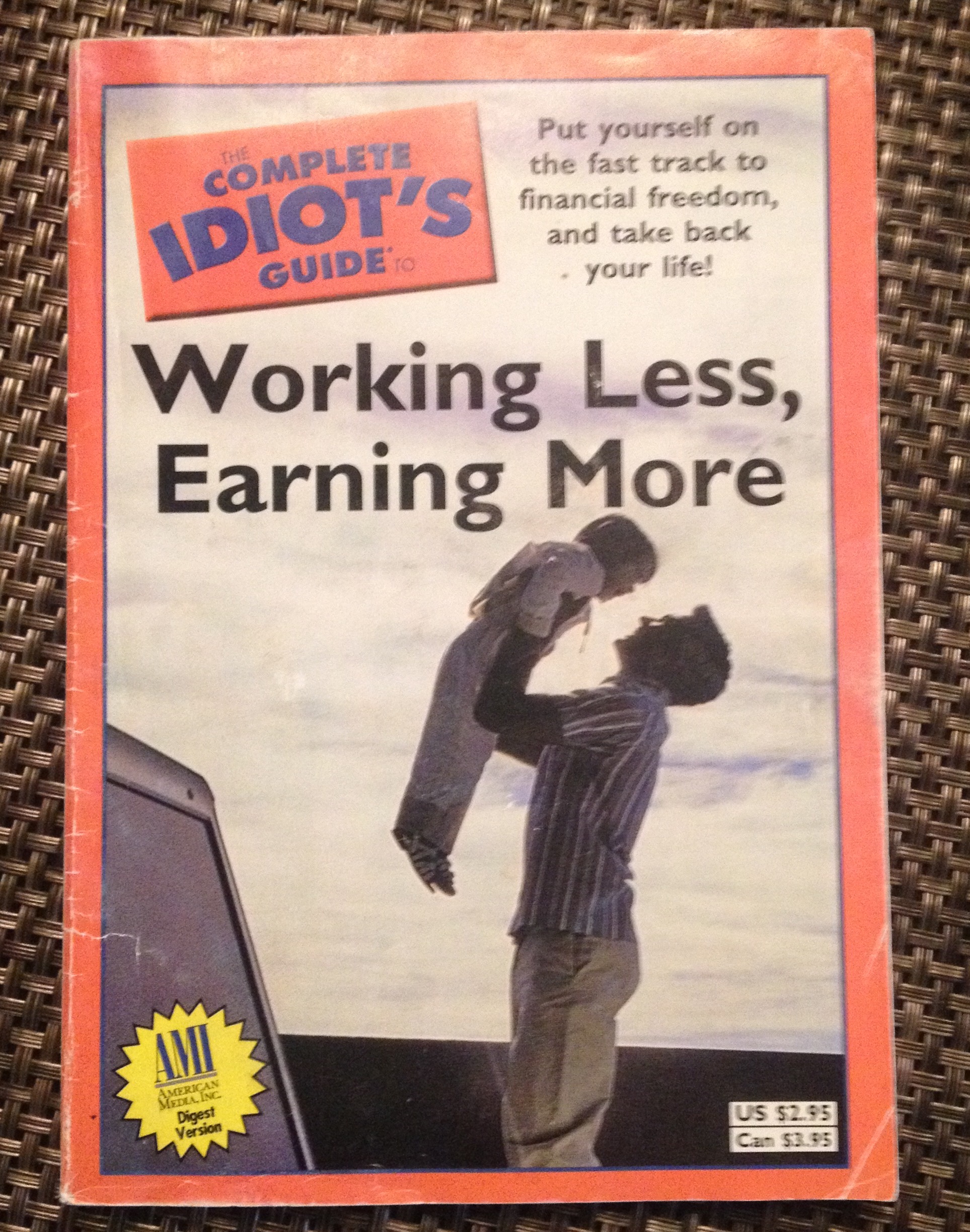
The book that gave me my entrepreneurial keys.
One day I was checking out at my neighborhood grocery store. While standing in line I came across the book shown above. Now, I was not necessarily interested in working less and earning more, but the title caught my attention. Needless to say the book’s author, Jeff Cohen, outlined a plan for transitioning from the working a gig life to working for ones self. So with that, I studied what the book had to offer and then moved towards building the plan.
Creating the backup plan
My plan to leave was actually broken down into the following three phases:
- Building the business part time
- Creating a fallback position within corporate
- Preparing to leave once when all of the pieces were aligned
The plan began in late 2005 and culminated with my resignation in January of 2012. So as you can see, it took almost 7 years for it to “fall into place” so to speak. In the next post I will elaborate on each of those phases and exactly how I prepared to leave (e.g. financial, health care, etc).
The Ultimate Black Friday Tax Prep Deal
What, a tax preparation Black Friday deal? How is that even possible? Isn’t tax season in like April? Yes, tax preparation may be the farthest thing from your mind given that yesterday most of us stuffed our tummies to the max. However, tax season IS just around the corner. But what’s even better is that we are going to give you several was to save some dinero IF you take advantage of our deal. So what’s included?
- A FREE copy of The Ultimate 100 tax tips guide
- 50% rebate if/when you purchase the book authored by our CEO Jared Rogers, CPA – Pathways To Wealth A Common Sense Guide to Personal Money Management and Lifestyle Techniques
- $25 Visa/AMEX gift card if you become a tax prep client in the 2016 filing season
- Complimentary sign up to our blog post going forward
As if all of the above wasn’t good enough, how would you like to get some extra money during the 2016 tax filing season? Well, if you send us your friends, family and co-workers and they become a client, we’ll give you $40 for EACH person you send us. While the details for tax year 2015 aren’t final just yet, it will operate very similar to our 2014 Referral Program. And the best part is that you DON’T have to be a client to earn referral commissions (you just have to tell your friends to mention that YOU sent them when they meet with us and we’ll do the rest).
How To Get This Deal
- Go back to the home page
- Enter in your email above the green “Get Guide” button
- Check your email account for a message with next steps and further instructions (it will be sent with 6-12 hours)
Instead of offering separate deals for Black Friday, Small Business Saturday and Cyber Monday, this deal will cover them all. As such, you must submit your email before it expires at 11:59PM on Tuesday December 1, 2015.
Uber, Lyft and Filing Your Income Taxes
We’ve all been there. The thought of being your own boss and leaving the 9-to-5, Monday-through-Friday grind to someone else. Some of us take that jump and for others, the confines of a nice cubicle and a predictable deposit into their bank account are more than enough. But what if you are thinking of striking out on your own and joining one of those ride share companies? Well, we strongly urge you to read this post as it has a LOT of information in it for you to consider before you take the plunge.
Worker Status
The first thing to know is that when you work for Uber or Lyft, you are not doing so as an “employee.” Instead, you will be classified as an independent contractor. As presented on Uber’s website:
“All Uber partners are independent contractors, so we do not withhold any taxes and partners are entirely responsible for their own tax obligations. If you’re a partner based in the United States, you will receive a 1099-K and/or 1099-MISC form to report income you earned with Uber. You’ll receive one or both depending on the type of payment you earned in the calendar year.”
In this post we discuss the implications of being paid as an independent contractor versus an employee. The big difference comes down to the fact that as an independent contractor 1) no taxes are taken out of the pay received and 2) the fact that the individual has to pay self-employment taxes in addition to income taxes.
Tax Considerations
In this post we talk about how those who are “self-employed” typically file their taxes and some of the issues they face. What we’ll now discuss are those items specific to “drivers for hire” like taxi, livery and ride share operators.
Income This one is pretty straightforward. You report all of the money that you received while operating, including tip income. Where we see people get into trouble is when they under report. What do we mean? Well, the IRS is going to get a copy of that 1099-K or 1099-MISC that you received. If you report at least the amount that is shown on the document then you probably won’t hear anything from the IRS. But if you report an amount that is LESS than what is shown, expect the IRS to come a knocking. Why? Well the IRS is going to ask you ” why did you only report $4,000 of income but Uber says you made $8,000? We think you made at least that much but your return doesn’t reflect that.”
Now what if you say “I didn’t get a form so the IRS doesn’t know what I made!” Can we say tax evasion? So make sure you report every red cent that you made to stay out of trouble okay?
Operating Expenses This one is the complicated one. A taxpayer who uses an automobile for business purposes can figure their deduction by comparing the standard mileage rate with actual expenses and choosing the larger amount. One would perform this analysis in every year and take the larger amount. However, if the actual expense method is chosen in the first year, it must be used in all subsequent years until the vehicle is no longer used for business.
If the standard mileage rate method is used, the deduction is calculated by multiplying the number of business miles driven by the applicable standard mileage rate. The standard mileage rate eliminates the need to keep track of actual costs. It is used to replace the “actual” cost of depreciation, lease payments, maintenance and repairs, gasoline, oil, insurance, and vehicle registration fees. It does not include:
- Interest expense for a self-employed individual
- Personal property taxes
- Parking fees and tolls
The expense above would (depending on the circumstances) be claimed in addition to the amount calculated via the standard mileage rate. Now, sometimes people (and tax practitioners) wonder if a “driver for hire” can use the standard mileage rate. Well back in 2010, the IRS issued Rev Proc 2010-51 and within it you can find that Rev Proc 2009-54 was modified as follows:
“Section 4.05(1) is modified to allow taxpayers to use the business standard mileage rate to calculate the amount of deductions for automobiles used for hire, such as taxicabs.”
You can also find language under the standard mileage discussion of Publication 463 that reads that “you can elect to use the standard mileage rate if you used a car for hire (such as a taxi) unless the standard mileage rate is otherwise not allowed, as discussed above.”
Now, If you decide to base your deduction on your actual expenses, note that you should keep track of the following:
- Business Percentage: The taxpayer must calculate the business percentage of vehicle expenses. Keep track of business miles driven for the year and divide that amount by the total miles driven for the year.
- Cost of depreciation (leave this to your tax software or gal/guy)
- Lease payments
- Registration fees
- Licenses
- Gas
- Oil
- Insurance
- Repairs
- Tires
- Garage rent
- Tolls
- Parking fees
- Sales tax paid on the purchase of a car is added to the basis of the car and deducted through depreciation.
- Fines for traffic violations are never deductible, even if incurred while driving for business.
Business Expenses This is for all of the items that aren’t directly related to the cost of vehicle operations, but are allowed. Buy bottles of water for your riders? Have to pay a monthly cell phone bill so that riders can hail you? Both are deductible expenses. We suggest that you consult Publication 535 to see what is allowed. The one thing to keep in mind is that if an item is used for both business and personal use, you should keep track of your business use as that is the percentage of the expense that you may deduct.
Comprehensive Example & Sample Tax Return
*** Note: This example was originally posted in 2015. It has been updated to reflect numbers applicable to 2022 and the associated tax returns.***
If you click this link, you will be able to download the sample tax return that is used in this example. Having it handy will help you quickly follow along with what we’re about to discuss. Disclaimer: This material has been prepared for informational purposes only, and is not intended to provide, and should not be relied on for, tax, legal or accounting advice. You should consult your own tax, legal and accounting advisors before engaging in any transaction. Okay, the lawyers are happy now. Shall we begin?

Need a Lyft?
So, our good friend Memphis Raines has decided to earn some extra cash with one of the ride share companies. He’s pretty good at what he does, get’s passengers to their place really fast and makes sure that he keeps and IRS Compliant Mileage Log (he doesn’t want the tax court disallowing his deduction). During the year he raked in close to $63,000 in income for all that driving. So what does Memphis’ tax return look like? Let’s examine it.
Page 3 shows Mr. Raines’ Schedule C or Profit or Loss From Business. He completes the top section listing all the pertinent information for his business. If you look at the form, you will see that it contains very little information. Looks like he spent close to $17,000 on car expense, another $143 on meals (drinks for his passengers) and another $2,000 for his business cell phone. But let’s look a little closer at the car expense.
As indicated above, Memphis is allowed to take the larger of his actual expenses OR the amount calculated by using the standard mileage rate. If you look at page 11, you can see all of the expense that Memphis spent to make that $63,000 in revenue. But the thing to note is that he used his car 80.4% for business. The rest of those miles? Well, let’s just say they were spent with his kid brother Kip and some girl named Sway! Anyway, looks like he spent $13,500 (ignoring the fact depreciation isn’t a cash expense) to make all that money. It also looks like he drove about 27,000 miles in a year – ouch! So if you take the standard mileage deduction ($0.605 in 2022 when you factor that the rate changed mid year) and multiply in by the business mileage, you get a deduction of around $16,700. Since that is larger than the actual expense deduction of $13,500, which do you think he will take?
Was it worth it?
So Memphis had fun driving around all year. But was it worth it? Only he knows the answer to that, but what we can analyze is the financial impact. Page 1 shows that Memphis had a net profit from business of around $44,100 (i.e. $63,000 in revenue less $18,900 in expenses). As Mr. Raines is single, he has very little other deductions. He takes the standard deduction and receives the 20% qualified business income deduction granted to those who are in business for themselves.
This leaves him with taxable income of around $22,400. On this income, he has to pay $2,486 in income taxes. But wait, Memphis is his own boss right? Well, that means that he has to pick up the share of Social Security and Medicare taxes that an employer usually has to pay for each employee it has. The bill? Another $6,200 in taxes! So Memphis winds up with a whopping tax bill of around $9,000. As he did not make estimated tax payments he’ll need to come up with a way to pay the IRS.
So in looking at this from another angle, Memphis took in $63,000. He spent another $11,000 in real cash to make all that money. He also has to pay the IRS around $9,000 in taxes. So net, he took home around $43,000 when it’s all said and done. Not bad for being your own boss. But he did put about 27,000 miles on that sweet car of his, which will make selling it harder once it’s days as a ride share vehicle are done and it’s just hanging out in videos by The Cult.
Need Tax help? Well, if all of this sounds like way too much to handle on your own and you’d rather let a professional deal with it, why not give us a call or shoot us an email? Our information can be found at the bottom of this page and we’d be happy to help make sure that you stay on Uncle Sam’s good side!

Click above to watch our Money Management and Tax Chit Chat video series!

Click Above For Your Top Secret Guide To Tax Reduction, Business Success and Solving IRS Debt Problems!

Click Above To Learn 111 Ways To Slash Your Tax Bill!