
Understanding The “New” Form 1040
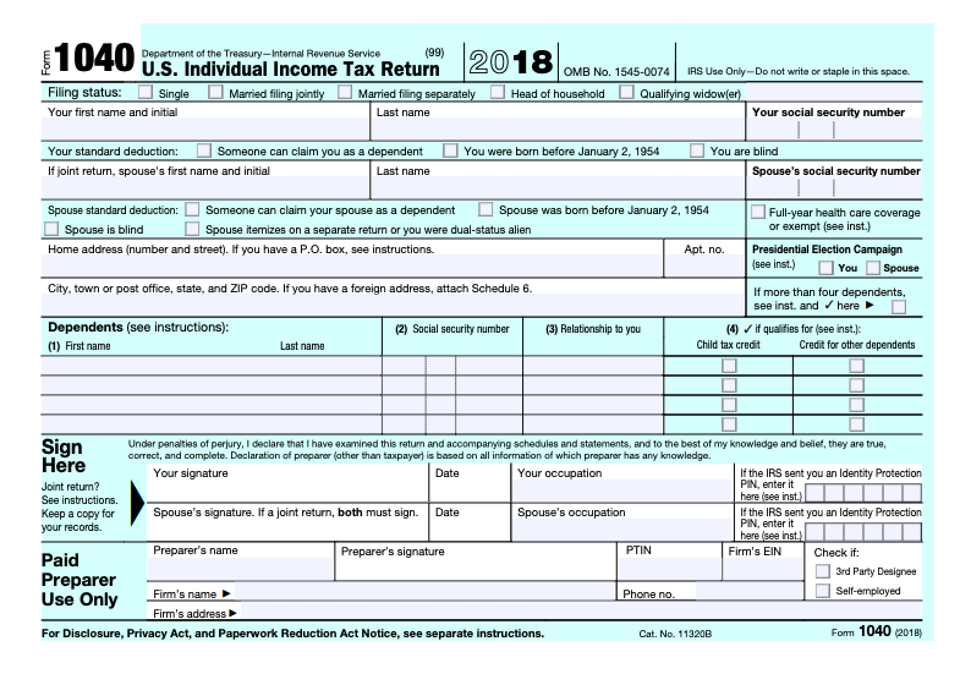
—Update 01/01/2020-The IRS modified some of these schedules effective with the 2019 Form 1040. Forms that only apply to tax year 2018 will link to the 2018 form only. —
So, when lawmakers vowed in 2017 to simplify the tax code, one of their targets was the good ‘ol IRS Form 1040 pictured above. There was much hoopla about making it so taxpayers could file their taxes on something about as big as a post card. Well, the new Form 1040 is smaller than it’s predecessors. But will it make the filing process more simplified? We don’t think so. Read on to see why.
More Schedules. The new Form 1040 replaces the former Form 1040 as well as the Form 1040A and the Form 1040EZ. The new Form 1040 uses a “building block” approach, in which the tax return is reduced to a simple form. That form can be supplemented with additional schedules if needed. Taxpayers with straightforward tax situations would only need to file this new 1040 with no additional schedules. But what if you do need one of the additional schedules? Well, just know that there are six new schedules to accommodate this approach. What are these new schedules?
Schedule 1 Additional Income and Adjustments to Income. This schedule is used to report all of the income that was reported on lines 10 and 21 of the 2017 form. This includes income from Schedule C (business income), Schedule D (capital gains and losses), Schedule E (supplemental income and loss from rental real estate) and Schedule F (farm and ranch income). It also includes the reductions to income that that were formerly reported on lines 23 to 35 of the 2017 form.
Schedule 2 Tax. This schedule reports lines 45 to 47 of the 2017 form 1040, including the tax, alternative minimum tax and any excess premium tax credit.
Schedule 3 Non-Refundable Credits. This schedule contains lines 48 to 55 of the 2017 form, including education expenses, child and dependent care credit, foreign tax credit, retirement savings plan credit and child tax credit.
Schedule 4 Other Taxes. This schedule contains lines 57 to 63 of the 2017 form, including self-employment tax, additional tax on IRA and retirement plan withdraws, household employment tax and the individual responsibility payment for not having health care.
Schedule 5 Other Payments and Refundable Credits. This schedule contains lines 65 to 74 of the 2017 form, including estimated tax payments and amounts applied to the next year’s return, earned income credit, additional child tax credit, American opportunity credit (the amount of the education credit that is refundable), amount paid with a request for extension and several other credits.
Schedule 6 Foreign Address and Third-Party Designee. This schedule is used to report your foreign address or if you would like the IRS to be able to discuss the return with a third party (e.g. your paid preparer).
Why Was This Done? Keeping politics out of the conversation, we believe that this switch was done to fulfill a campaign promises. Why so?
- The new building block approach doesn’t actually simplify anything. If anything, it makes one have to look at additional forms/pages when one only had to formerly look at a two page document (i.e. the old “long form” 1040) to see it all.
- Only around 13% of tax returns are file via paper as opposed to being e-filed according to the IRS statistics. With that being said, who really cares if the Form 1040 is the size of a postcard? Most people who file are using software!
- Schedules 1 through 6 are additional to the ones that existed prior to 2018 (e.g. Schedules A, C, D, E, F, H, SE and 8812). While taxpayers can ignore them if they don’t have any lines on those schedules to fill out, they still might have to review them to determine if they are required. Simplification? We’re not so sure.
The Result? While the new form is shorter, we can’t say that it will be easier for taxpayers to understand. We have already started preparing 2018 returns and we can say that it makes it “slightly” more challenging to review. Most professional software has a view/comparison mode/worksheet that allows us to analyze variances to ensure nothing is missed. But we can say that the building block scheme takes a little extra work.
To that end, don’t expect it to cost you any less to have your “simplified” tax return prepared when compared to years past. Most paid preparers, if anything, are actually raising their prices to accommodate the extra forms and other changes such as the 20% QBI deduction.
S-Corp Automobile Deduction

Who owns the vehicle matters!
You want your S-Corporation (S-Corp) to have a nice clean set of books, and the cleaner they are, the better. Corporate payments of personal expenses either dirty up the accounting or can create a strong impression of impropriety. The IRS is attracted to things that look suspect, which is an even better reason for you to make sure your S-Corp has a clean set of books. So how does one go about deducting the expenses of a vehicle that is used by a S-Corp. Well, the answer depends largely on who the vehicle is titled to.
Vehicle Titled In Corporation’s Name. Corporations, S-Corps, and Partnerships may only claim actual expenses for vehicles. Thus, your S-Corp may claim depreciation, fuel expenses, oil expenses, repairs, insurance, and so forth. But what about mileage? When the car is owned in the corporation’s name, it is not allowed to deduct mileage, just the actual expenses incurred for it’s use in business.
Vehicle Titled Personally. To deduct the expenses of a vehicle that is owed personally by the business owner, the S-Corp can reimburse the employee expenses under an accountable plan or a non-accountable plan. The expenses are deductible under either methodology, but the rules are different.
Accountable Plan
When an accountable plan is used, the business only reimburses expenses that are substantiated (proved) by receipts and other documentation. The reimbursements are not taxable income to the business owner nor are they reported on their W-2. What the owner needs to submit to the business depends on what expenses they will be reimbursed for. In this post about S-Corp Home Office Deductions, we provide a sample accountable plan that will give you an idea of the reimbursement language.
- Mileage Reimbursement. The business can reimburse at the IRS standard mileage rate. This rate includes allowances for depreciation (i.e. wear and tear), maintenance, repairs, gas, insurance, and a host of other things. The proof the business owner would need to provide for reimbursement would be a mileage log. This log would need to show the date, business purpose of the trip, miles driven and should be submitted to the business on a routine and timely fashion (e.g. once a month). One important thing to note is that the standard mileage method only applies to passenger vehicles with a gross weight of less than 6,000 pounds.
- Actual Expense Reimbursement. The business can also reimburse for the actual expenses the business owner incurs. The business does not have to reimburse for every expense, for example, you could reimburse gas and insurance and not tires and oil changes. However, for any expenses the business does reimburse, it must have adequate proof. Adequate proof means you need to see all the receipts for the expenses that will be covered. In addition to the expenses, the owner also needs to supply the total vehicle mileage for the year as well as the mile log. Why? So it can determine the number of business miles and the number of personal miles to compute the percentage of business use. This percentage is then applied to the total amount of expenses incurred to determine how much is reimbursed to the employee.
Non-accountable plan
If a non-accountable plan is used, then the business does not need to keep or see any vehicle records. They can reimburse any amount, from below the IRS standard rate, or above the IRS standard rate. They can reimburse for gas and insurance but not oil changes, or anything else that it wants to pay for (that is vehicle related). But under this method, all the reimbursements get included in the employee’s box 1 W-2 wages and are subject to income and employment tax withholding. The non-accountable plan is less beneficial to the employee because of the inclusion of the amounts on their W2 as income.
Could you be paying more in taxes than you should?
As a business owner, there are some tax benefits to being structured as a S-Corp. The biggest one (that almost everyone knows) is the potential to reduce/minimize their employment taxes. But did you know that through some deliberate and diligent tax planning, you could be able to legally reduce your tax burden further?
If your business does $100K (or more) in revenue, you would be a perfect candidate for our S-Corp Tax Reduction Analysis. This analysis (a package valued at $1097, but $345 to you for a limited time), includes the following:
- One hour investigative session to understand your business operations and potential tax levers
- Review of the past 3 years of filed Form 1120S tax returns to unearth potentially missed deductions or tax savings
- Formulation of potential tax strategies that if implemented could reduce the underlying tax liability
- Comprehensive report indicating findings, tax strategies and steps to implement
- Complementary copy of Jared’s book How to Slash Your Taxes Legally and Ethically
Furthermore, this analysis is guaranteed by our 100% ironclad money back guarantee. If we can’t find any tax savings that equal or exceed the cost of the analysis, we’ll refund your money, no questions asked!
To claim your analysis, simply email us via the address in the footer on this page or give our office a call at 773-239-8850. We only have capacity to perform so many of these analysis per month so get yours NOW. We look forward to working with you!
Should I Hire a Tax Professional For My Small Business?

Do I really need a tax professional?
For taxpayers with the simplest income tax returns, do-it-yourself software and websites often seem like the way to go. These individuals often have only one source of income (i.e. W2 from their employer), may have a home mortgage with interest, some student loan debt and maybe some childcare credits. But for those with more complex situations, such as revenue from businesses, income from interest and dividends, capital gains on a home sale or foreign assets, seeking the expertise of a professional can save time, money and potential legal complications.
For small business owners, and many other taxpayers, there are several reasons why seeking a tax professional might be better than going it alone. In this post, we’ll discuss some of the most common and influential drivers that typically signal it’s time to make the switch.
Types of Tax Advisors
The first thing to know is that anyone can claim to be a tax expert. Furthermore, there is no requirement that people who prepare tax returns have to be licensed by the IRS. With that being said, note that there are (generally) three designations when it comes to tax professionals:
- Enrolled agent (EA). An EA is licensed by the IRS and has either passed a difficult test or has at least five years of experience working for the IRS. EAs are “generally” the least expensive of the tax pros and often offer bookkeeping and accounting assistance.
- Certified public accountant (CPA) and other accountants. CPAs are licensed and regulated by each state. They perform sophisticated accounting and business-related tax work and prepare tax returns. Larger businesses or businesses with complex business tax returns often use CPAs. The larger CPA firms (e.g. The Big 4) are expensive. Smaller CPA firms and practitioners can be less expensive and may be better suited for the typical small business.
- Tax Attorneys. Tax Attorneys are lawyers with a special tax law degree (called an L.L.M. in taxation) or a tax specialization certification from a state bar association. Tax attorneys can be expensive, but you should consult one if you have a tax problem, are in criminal trouble with the IRS, need legal representation in court, or need business and estate planning.
Reasons to Hire A Tax Professional
So when is the right time to hire one of the individuals listed above? Typically, it’s once one of the following items below occurs:
- Your tax situation exceeds your expertise or your software. Even what may seem like a “straightforward” situation can quickly turn into more than one bargained for. For example, let’s say that you drive for one of those ride share companies. At tax time, you receive a Form 1099-K, a Form 1099-MISC and a Yearly Summary. Some of the documents include numbers from one of the other documents, and some documents appear to have totally different numbers. Some have fees that “may be deductible” but you aren’t sure which ones to include. Do you add them all? Do you only include some? What if you leave a number off that should have been reported? A tax professional can help ensure everything is reported correctly and that you don’t wind up getting an IRS Automated Adjustment Notice for under reporting your income.
- Your time is valuable and you’re spending too much of it preparing your return. While you may be able to prepare your taxes yourself for $100 or less online, many do-it-yourself filers spend an enormous amount of time when doing so. According to the 2018 Form 1040 Instructions per the IRS, the average taxpayer will spend 11 hours preparing their return.
This number jumps to 19 hours if you have a business! Hiring a professional can reduce that to the time it takes to gather your tax documents and forward them to their office, go over a few items with them and then review the final return for accuracy. If your time is better spent closing sales deals, running your business or spending it with family and friends, then hiring a tax professional can make perfect cents (pun intended).Average Taxpayer Burden for Individuals Average Time (Hours) Type of Taxpayer Percentage
of ReturnsTotal
TimeRecord
Keeping
Tax
Planning
Form
Completion &
SubmissionAll
Other
Average
Cost
(Dollars)All taxpayers 100% 11 5 2 4 1 $200 Nonbusiness 70% 7 2 1 3 1 $110 Business 30% 19 10 3 5 1 $400 Estimated Average Taxpayer Burden for Individuals by Activity per 2018 Form 1040 Instructions - You could be missing out on valuable deductions. In addition to saving you countless hours of painfully boring and costly tax guessing, experienced preparers know the deductions that you may qualify for, and which items are tax deductible if you own a business. They can also easily tell you if it’s more beneficial to itemize or take the standard deduction. Even if you just earn only a little income on the side, a professional may be able to find you deductions or credits that will more than pay for their services and keep more of your hard earned money out of the pockets of Uncle Sam. Lastly, the cost of having your taxes prepared by a professional can also be tax deductible as a professional fee if you have a business.
- The tax law is constantly changing. Adding to the complexity, new tax laws are enacted every year that affect virtually everyone, making it tough to keep up with changes and how they might affect you. For example, the new 20% Qualified Business Income Deduction will no doubt cause some frustration for those this tax year (especially if you in the “phase in” range for a partial deduction). For small businesses that have to manage income tax withholding and reporting for their employees, taxes are even more complex. While tax software can help, an experienced professional that “has seen it all before,” and also keeps up with tax law changes through educational courses, can make the process easy peasy lemon squeezy!
- A mistake was made in the past. If you do your taxes yourself, you are much more likely to make a mistake. Mistakes happen, but when they happen to you, it may feel like they are costing you big time. A simple math error can cause a return to be inaccurate, leaving you liable for unpaid taxes and interest. For errors the IRS believes are not accidental, such as failing to report income, taxpayers can also face large fines and even criminal prosecution. A skilled tax professional can not only help ensure that your returns are accurately prepared, but they often can help you rectify a past mistake.
- You want peace of mind. The only people that look forward to an IRS audit are IRS auditors! The best way to avoid their scrutiny is to make sure your tax return is in compliance with the tax laws. To do that, why not hire a professional who lives, works and breathes taxes every day (or at least a lot more frequently than you do)? There is still a chance than any taxpayer will get audited, but if you use the services of a professional CPA, Enrolled Agent or Tax Attorney, and your return is selected for further inspection by the IRS, those professionals can typically help represent you on your behalf before the IRS. Don’t go before a court without a lawyer, and don’t go before the IRS without a professional.
How much does it cost to hire a tax professional?
According to the 2018 survey by the National Society of Accountants, the average federal tax return in the U.S., including the tax return for the person’s state of residence, cost $294 for a professional preparer to handle if the taxpayer itemizes and $188 if they don’t. If you own a business that needs to file a Schedule C (for business income and expenses) that will tack on $187 more. But as outlined above, there are numerous reasons why this cost can be well worth it.
Do you need help with your business taxes this year?
If you don’t want to deal with the hassle and headache of navigating the new tax law, or simply don’t have the time, we’d be happy to assist you! Call the office now to schedule your appointment or request your complementary tax situation analysis (valued at $197 but free if you mention this blog post). We are a year round practice and can even help you file your state taxes no matter where you are located.
What is the 20% QBI Deduction?
In late 2017 with the passage of the Tax Cuts and Jobs Act (TCJA), a new 20% deduction for pass through businesses was created. This deduction is also known as the section 199A deduction, the deduction for qualified business income (QBI), the 20% deduction and the pass-through deduction. In this post, we’ll discuss who can take the deduction, how it is calculated and provide some examples to aid in ones understanding.
Who may take the section 199A deduction? Generally speaking, individuals, trusts and estates with QBI, qualified REIT dividends or qualified publicly traded partnership (PTP) income may qualify for the deduction. This income must be derived from a qualified trade or business operated directly or through a pass-through entity. From an “entity” standpoint, the following are those that may be able to take the deduction:
- Partnerships
- S-Corporations
- Sole proprietorship’s (i.e. Schedule C filers)
- LLCs
- Real estate investors
- Trusts, estates, REITs and qualified cooperatives
So as you can see, the deduction is intended for those entities that are not classified as C-Corporations. Why? We’ll since the TCJA cut the corporate income tax rate to a flat 21%, this was the way to replicate a similar treatment for those entities that were not structured as such.
What is QBI? QBI is the net amount of qualified income, gain, deduction and loss from any qualified trade or business. Only items included in taxable income are counted. In addition, the items must be effectively connected with a U.S. trade or business. Items such as capital gains and losses, certain dividends and interest income are excluded.
What is not QBI? QBI is not items used in determining net long-term capital gain or loss, dividends, interest income, reasonable compensation, guaranteed payments or amount paid or incurred by a partnership to a partner who is acting other than in his or her capacity as a partner for services
What is a qualified trade or business? It is any trade or business other than one of the following:
- One that is defined as a specified service trade or business (SSTB), which includes those that involve the performance of services in the fields of health, law, accounting, actuarial science, performing arts, consulting, athletics, financial services, investing and investment management, trading, dealing in certain assets or any trade or business where the principal asset is the reputation or skill of one or more of its employees.
- One that involved performing services as an employee (i.e. one in which you receive a W2)
What information should my K1 have on it for me to take the QBI deduction? If a K1 fails to report any item below, the IRS will presume that the QBI, W-2 wages and the unadjusted basis immediately after acquisition (UBIA) of qualified property are equal to zero:
- Whether the business is an SSTB.
- Whether there is more than one trade or business.
- QBI for each trade or business.
- W-2 wages and UBIA of qualified property.
- Any REIT dividends.
- Any PTP income.
How is the deduction for QBI calculated? Now this is where things “can” get complicated. In the simplest application, the deduction is equal to 20% of domestic QBI from a qualified trade or business. The deduction is taken on an individuals personal return and “below the line.” Thus, it reduces taxable income and not adjusted gross income (AGI). The following 199A Calculator will give you a quick idea of how it works and what a QBI deduction might look like for your situation.
The calculation itself, is dependent on the taxable income reflected on the taxpayers return:
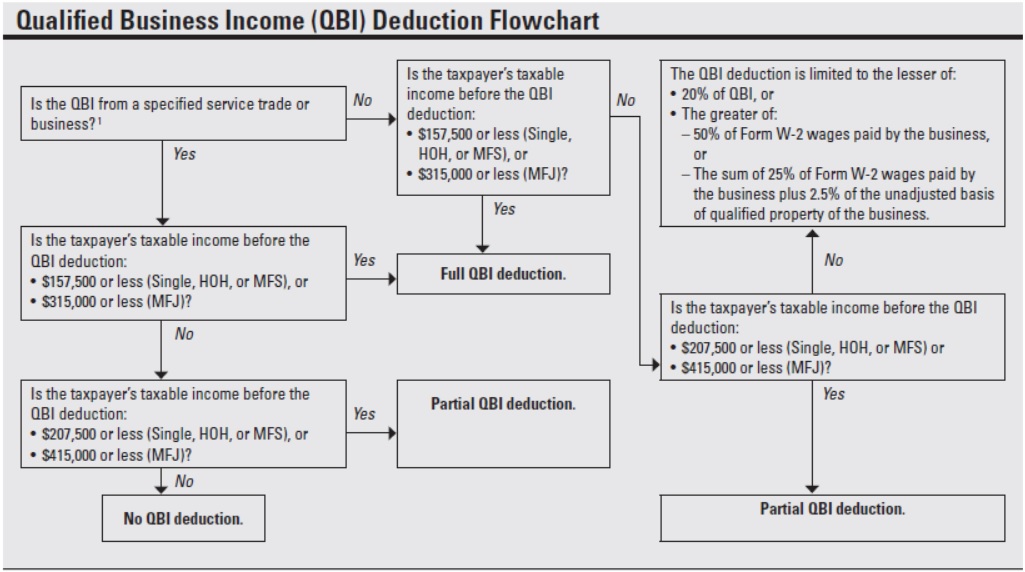
Below threshold: If a taxpayer’s taxable income is below $315,000 for a married couple filing a joint return and $157,500 for all other taxpayers; the deduction is the lesser of:
- 20% of the taxpayer’s QBI, plus 20 percent of the taxpayer’s qualified real estate investment trust (REIT) dividends and qualified PTP income or
- 20% percent of the taxpayer’s taxable income minus net capital gains.
So basically, the deduction will never be greater than 20% of the taxpayers QBI or their taxable income. Now what happens if the income is above the amounts specified above?
Between threshold: If the taxpayer’s taxable income is between thresholds (i.e., between $315,000 and $415,000 for married taxpayers filing jointly; between $157,500 and $207,500 for others), the QBI deductible amount for the business is subject to a limitation based on W-2 wages and/or UBIA. In these instances, the deduction is calculated as:
- 20% of QBI for that trade or business less,
- An amount equal to the reduction ratio multiplied by the excess amount.
- The “reduction ratio” is calculated as (Taxable income – $315,000)/$100,000 for those filing MFJ and (Taxable income – $157,500)/$50,000 for all other taxpayers
- The “excess amount” is the amount by which 20% of QBI exceeds the greater of:
- 50% of Form W-2 wages paid by the business, or
- 25% of Form W-2 wages paid by the business plus 2.5% of the UBIA
Above threshold: If the taxpayer’s taxable income is above the thresholds (i.e., $415,000 for married taxpayers filing jointly and $207,500 for others), the deduction is:
- the lesser of
- 20% of QBI for that trade or business OR
- the greater of
- 50% of W-2 wages for that trade or business OR
- 25% of W-2 wages for that trade or business PLUS 2.5% of the UBIA of all qualified property
I have income from a SSTB. How does that affect my deduction? Your ability to take the deduction will depend on your taxable income and will be calculated as follows:
- The limitation does not apply to any taxpayer whose taxable income is below the $315,000/$157,500 threshold amounts.
- For taxpayers whose taxable income is within the phase-in range ($315,000 to $415,000 for joint filers and $157,500 to $207,500 for all other filing statuses), the taxpayer’s share of QBI, W-2 wages and UBIA of qualified property related to the SSTB may be limited/reduced (see Example 5 below)
- If the taxpayer’s taxable income exceeds the phase-in range (i.e. greater than $415,000 for joint filers and $207,500 for all other filing statuses), no deduction is allowed with respect to any SSTB.
I am a visual person. Do you have a flowchat to illustrate what all of the above means?
Ask and you shall receive. Take a look at the graphic below (absent some of the calculations).
Calculation examples using various ranges and business types. On August 8, 2018, the IRS released proposed regulations on §199A, providing guidance on their interpretation of provisions regarding the new 20% deduction for pass-through entities. The proposed regulations span 184 pages and provide numerous definitions, examples, and anti-abuse provisions. As such, it’s a good idea to review the examples in the link (see page 114/184) as the IRS has outlined computations for many scenarios.
The examples shown below are designed to help you gain a general understanding of how the information presented above comes into play.
Income below threshold examples
Example 1 In 2018, Pilar, an unmarried individual, operated an accounting and tax business (a SSTB) as a sole proprietor and earned a net Schedule C income of $100,000. She did not have any capital gains or losses. She claimed the standard deduction of $12,000 so her taxable income was equal to $88,000.
Pilar’s QBI deduction is $17,600, the lesser of 20% of her QBI ($100,000 x 20% = $20,000) or her taxable income minus long-term capital gain ($88,000 x 20% = $17,600). Because she is in the lowest range, the fact that she operates SSTB is irrelevant.
Example 2 Assume the same facts as above except that Pilar had $7,000 in long term capital gains. Pilar’s QBI deduction is $16,200, the lesser of 20% of her QBI ($100,000 x 20% = $20,000) or her taxable income minus long-term capital gain ($88,000 – 7,000 = $81,000 x 20% = $16,200).
Example 3 Popeye and Olive Oyl are married and file a joint individual income tax return. Popeye earned $300,000 in wages as an employee for the Department of Defense in 2018. Olive Oyl owns 100% of the shares of Alessi, an S corporation that manufactures olive oil. Alessi generated $100,000 in net income from operations in 2018. Alessi paid Olive Oyl $150,000 in wages in 2018. Neither Popeye or Olive Oyl have any capital gains or losses. After allowable deductions not related to Alessi (i.e. personal itemized deductions) , Popeye and Olive Oyl’s total taxable income for 2018 is $300,000.
Popeye and Olive Oyl’s wages are not considered to be income from a trade or business for purposes of the QBI deduction. Because Alessi is an S corporation, its QBI is determined at the S corporation level. Alessi’s QBI is $100,000, the net amount of its qualified items of income, gain, deduction, and loss. The wages paid by Alessi to Olive Oyl are considered to be a qualified
item of deduction for purposes of determining Alessi’s QBI.
The QBI deduction with respect to Alessi’s QBI is then determined by Olive Oyl, Alessi’s sole shareholder, and is claimed on the joint return filed by Popeye and Olive Oyl. Their QBI deduction is equal to $20,000, the lesser of 20% of Olive Oyl’s QBI from the business ($100,000 x 20% = $20,000) or 20% of Popeye and Olive Oyl’s total taxable income for the year ($300,000 x 20% = $60,000).
Income within threshold examples
These limitations are phased in for joint filers with taxable income between $315,000 and $415,000, and all other taxpayers with taxable income between $157,500 and $207,500.
Example 4 Bonnie and Clyde are married and file a joint individual income tax return. Bonnie is a shareholder in Public Enemy, an entity taxed as an S corporation for Federal income tax
purposes that conducts a single trade or business (freight operations). Public Enemy holds no qualified property.
Bonnie’s share of Public Enemy’s QBI is $300,000 in 2018. Bonnie’s share of the W-2 wages from Public Enemy in 2018 is $40,000. Clyde earns wage income from employment by an unrelated company. After allowable deductions unrelated to Public Enemy, Bonnie and Clyde’s taxable income for 2018 is $375,000. Bonnie and Clyde are within the phase-in range because their taxable income exceeds the applicable threshold amount, $315,000, but does not exceed the threshold, or $415,000. Consequently, the QBI component of Bonnie and Clyde’s QBI deduction may be limited by the W-2 wage and UBIA limitations but the limitations will be phased in.
The UBIA of qualified property limitation amount is zero because Public Enemy does not hold
qualified property. Bonnie and Clyde must apply the W-2 wage limitation by first determining
20% of Bonnie’s share of Public Enemy’s QBI. This amount equals $60,000 ($300,000 x 20%). Next, Bonnie and Clyde must determine 50% of Bonnie’s share of Public Enemy ’s W-2 wages. This amount is $20,000 ($40,000 x 50%).
Because 50% of Bonnie’s share of Public Enemy’s W-2 wages ($20,000) is less than 20% of her share of Public Enemy’s QBI ($60,000), Bonnie and Clyde must determine the QBI component of deduction by reducing 20% of Bonnie’s share of Public Enemy’s QBI by the reduction amount.
Bonnie and Clyde are 60% through the phase-in range (that is, their taxable income of $375,000 exceeds the threshold amount by $60,000 and their phase-in range is $100,000). Bonnie and Clyde must determine the excess amount, which is the excess of 20% of Bonnie’s share of Public Enemy’s QBI, or $60,000, over 50% of Bonnie’s share of Public Enemy’s W-2 wages, or $20,000. Thus, the excess amount is $40,000. The reduction amount is equal to 60% of the excess amount, or $24,000 ($40,000 x 60%).
Thus, the QBI component of Bonnie and Clyde’s deduction is equal to $36,000, 20% of Bonnie’s $300,000 share Public Enemy’s QBI (that is, $60,000), reduced by $24,000. Bonnie and Clyde’s QBI deduction is equal to the lesser of (i) 20% of the QBI from the business as limited ($36,000) or (ii) 20% of Bonnie and Clyde’s taxable income ($375,000 x 20% = $75,000). Therefore, Bonnie and Clyde’s deduction is $36,000 for 2018.
Example 5 Assume the same facts as in Example 4, except that Public Enemy was engaged in a SSTB (consulting). Because Bonnie and Clyde are within the phase-in range, Bonnie must reduce the QBI and W-2 wages allocable to Bonnie from Public Enemy to the applicable percentage of those items as a proportion to the phase out range. Furthermore, she must apply a reduction amount to the calculation.
The applicable percentage equals 100% minus the percentage obtained by dividing (a) the pre-QBI deduction taxable income of the taxpayer in excess of the applicable threshold amount by (b) $100,000 for joint-return filers or $50,000 for other filers. Reduction amount means, the excess amount multiplied by the applicable percentage. It is calculated as 20 percent of QBI over the greater of 50 percent of W-2 wages or the sum of 25 percent of W-2 wages plus 2.5 percent of the UBIA of qualified property.
For Bonnie and Clyde’s applicable percentage, their taxable income ($375,000) exceeds their threshold amount ($315,000) by $60,000. A ratio of 60% (i.e. $60,000/$100,000) is what is used to find their applicable percentage of 40% (i.e. 100% – 60% = 40%). Accordingly, in computing the QBI deduction, the couple would only be allowed to take into account 40% of the QBI, W-2 wages, and qualified property with respect to the trade or business.
Thus Bonnie’s QBI is “adjusted” to $120,000 ($300,000 x 40%) and her share of W-2 wages is “adjusted” to $16,000 ($40,000 x 40%). These “adjusted” numbers must then be used to determine how Bonnie’s QBI deduction is limited. The deduction will be limited to the lesser of:
- (i) 20% of Bonnie’s share of Public Enemy’s QBI or
- (ii) the greater of the W-2 wage or UBIA of qualified property limitations.
- Twenty percent of Bonnie’s share of QBI of $120,000 is $24,000.
- The W-2 wage limitation equals 50% of Bonnie’s share of Public Enemy’s wages ($16,000 x 50%) or $8,000.
- The UBIA of qualified property limitation equals $0
To calculate the reduction amount Bonnie and Clyde must first determine the excess amount. This is calculated as the excess of 20% of Bonnie’s share of Public Enemy’s QBI, as adjusted ($24,000), over 50% of Bonnie’s share of Public Enemy’s W-2 wages, as adjusted ($8,000). Thus, the excess amount is $16,000. The reduction amount is equal to 60% of the excess amount or $9,600. Thus, the QBI component of Bonnie and Clyde’s QBI deduction is equal to $14,400 ($24,000 – $9,600).
As Bonnie and Clyde’s QBI deduction is equal to the lesser of (i) 20% of the QBI from the business as limited ($14,400) or 20% of Bonnie’s and Clyde’s taxable income ($375,000 x 20% = $75,000), their QBI deduction is $14,400 for 2018.
Income above threshold examples
Example 6 Ernie, an unmarried individual, is a 30% owner of Bert LLC, which is classified as a partnership for Federal income tax purposes. In 2018, Bert LLC has a single trade or business (landscaping) and reported QBI of $3,000,000. Bert LLC paid total W-2 wages of $1,000,000, and its total UBIA of qualified property is $100,000. Ernie is allocated 30% of all items of the partnership. For the 2018 taxable year, Ernie reports $900,000 of QBI ($3,000,000 x 30%) from Bert LLC . After allowable deductions unrelated to Bert LLC (i.e. personal itemized deductions), Ernie’s taxable income is $880,000.
Because Ernie’s taxable income is above the threshold amount, the QBI component of Ernie’s QBI deduction will be limited to the lesser of:
- (i) 20% of Ernie’s share of Bert LLC’s QBI or
- (ii) the greater of the W-2 wage or UBIA of qualified property limitations.
So while it might not be clear, there are three calculations related to the two bullets above:
- Twenty percent of Ernie’s share of QBI of $900,000 is $180,000.
- The W-2 wage limitation equals 50% of Ernie’s share of Bert LLC’s wages ($1,000,000 x 30% = $300,000 x 50%) or $150,000.
- The UBIA of qualified property limitation equals $75,750, the sum of:
- (i) 25% of Ernie’s share of Bert LLC’s wages ($1,000,000 x 30% = $300,000 x 25%) or $75,000 plus
- (ii) 2.5% of Ernie’s share of UBIA of qualified property ($100,000 x 30% = $30,000 x 2.5%) or $750.
For items 2 and 3 above, the greater of the limitation amounts ($150,000 and $75,750) is $150,000.
The QBI component of Ernie’s QBI deduction is thus limited to $150,000, the lesser of (i) 20% of QBI ($180,000) and (ii) the greater of the limitations amounts ($150,000). Ernie’s QBI deduction is equal to the lesser of (i) 20% of the QBI from the business as limited ($150,000) or (ii) 20% of Ernie’s taxable income ($880,000 x 20% = $176,000). Therefore, Ernie’s QBI deduction is $150,000 for 2018.
Ready to get help? As you can tell, the computations involved in taking the deduction get more complicated depending on the taxpayers income. If you don’t want to go through the mechanics of calculating your QBID and ensuring it is correct, why not let a professional do the work? Feel free to give us a call or drop us an email and we’d be happy to assist you ensure that everything is done correctly. Plus, you won’t have to spend the time doing it!
What Is An Eligible Education Institution?

Do I get a tax write off for this?
The IRS provides taxpayers certain tax breaks when you pay for education. However, there is a catch. The monies paid (i.e. tuition) have to be to an eligible education institution. What exactly is that? Read on my friend.
Tax Benefits Available
The following are the benefits commonly available to taxpayers:
- Tuition and Fees Deduction: The tuition and fees deduction can reduce the amount of your income subject to tax by up to $4,000. You may be able to deduct qualified education expenses for higher education paid during the year for yourself, your spouse or your dependent.
- American Opportunity Tax Credit: A credit for tuition, required enrollment fees and course material for the first four years of post-secondary education for up to $2,500 per eligible student per year. Your modified adjusted gross income (MAGI) must be under $90,000 ($180,000 for joint filers) and you must not have claimed the AOTC or the former Hope Credit for more than four tax years for the same eligible student. Forty percent of this credit may be refundable.
- Lifetime Learning Credit: The Lifetime Learning Credit is 20% of the first $10,000 of qualified education expenses paid for all eligible students. The maximum credit is $2,000 per return regardless of the number of eligible students. There is no limit on the number of years the credit can be claimed for each student; thus the reason it is referred to as “lifetime.”
Eligible Education Institution Defined
An eligible educational institution is a school offering higher education beyond high school. It is any college, university, trade school, or other post secondary educational institution eligible to participate in a student aid program run by the U.S. Department of Education. This includes most accredited public, nonprofit and privately-owned–for-profit post secondary institutions.
With that said, if you are attending a school in another country, there is a possibility that it is NOT considered an eligible education institution. In general, if you aren’t sure if your school is an eligible educational institution:
• Ask your school (i.e. someone in the financial aid department) if it is, or
• See if your school is on the U.S. Federal Student Aid Code List.
TIP: A small number of schools, not on the list, may be eligible educational institutions and the school can confirm that for you.

Click above to watch our Money Management and Tax Chit Chat video series!

Click Above For Your Top Secret Guide To Tax Reduction, Business Success and Solving IRS Debt Problems!

Click Above To Learn 111 Ways To Slash Your Tax Bill!