
The Advantage of Being A “Small” Business
This past weekend my family and friends celebrated our daughter Pilar’s 3rd birthday. Her grand event was held at the Bronzeville Children’s Museum which meant that I would have the designated job of “goffer” until it was done. One of the things on my list was getting two Yo Gabba Gabba character balloons filled with helium so that I could bring them to the party.
Well, in case you didn’t know there is apparently a shortage of helium going on currently. Seems like it happens on an annual basis, but this year party store retailers appear to be limited in their ability to obtain it. Unless you are in the medical, brewing or welding industries, you are not considered top priority. Thus, many of the retailers who are selling it have their own restrictions on how they dole it out. Unfortunately, one of the restrictions that I came across from the “big boys” was that they weren’t filling outside balloons with helium, only ones that were purchased from them.
If you’ve ever hosted a kid’s party, you can relate to the stress of trying to make it all come together. Needless to say, after going to a couple of the big stores I was getting pretty fed up with the inability to get these balloons filled. So I decided that I would take a different approach, I’d find a “small business” that specialized in party decorations and the like.
This is where my friend Jo Jo The Balloon Lady enters. You see, this is a shop that I have seen on my way to our office quite a few times. I’ve never had a reason to frequent their establishment before this, but as I knew where it was I figured I would see if they would fill my balloons. I was greeted by a young woman who promptly took my order and told me that it wouldn’t be a problem to get them filled. It would cost me a little more than normal due to the helium shortage, but as a parent you know there is no price too great when it comes to your child’s happiness.
During this time I also got to speak with the proprietor and learn a little more about their business and just how long they had been there (15 years). I learned about the passion they had for the business, their commitment to it and just how much their customers meant to them. I vowed that they would have my business in the future and that I would spread the word about what a gem this little place was. Which brings me to the subject of this post.
When you’re small business, you have a set of competitive advantages that larger competitors may not. Thus, always make sure that you leverage the following as they are true tools that can bring you business:
Genuine Customer Service. The customer service experience is one that can make or break your opportunity to turn a first time customer into a repeat one. To this end, make sure that your staff is fully vested in just how important it is to make each customer happy. Whether it’s engaging in conversation, listing to their stories or just greeting them with a smile, make it a part of your operating procedures.
Opportunistic Thinking. Small businesses are started and run by entrepreneurs. These are the type of people that see a problem and try to build a better mouse trap to solve it. Likewise, they are also the ones most likely to “think outside the box” so to speak. So when the big boys set a certain status quo in the market, but you can figure out a way to capitalize on it, by all means go for it. “So you don’t want to fill outside balloons because you want the increased margin that comes with people buying balloons from you? That’s okay, we’ll fill all the balloons you won’t and make a nice little penny off it too!”
Build Relationships. I’ve said it before but I’ll mention it again; people do business with people they like. Better yet, people will go out of their way to rant, rave and refer business to people they like. So treat every customer as a friend and invite them to get to know you. Likewise, just like Sal the butcher learned that you would want your “special cut” of meat every Friday, make it a point to learn what makes your customers happy. You’ll soon find that by building these relationships you’ll have the opportunity to service a customer for a lifetime versus just a single transaction.
Taxes When You Live In One State & Work In Another
Q: I just took a new job, but heard that it may make my tax situation a little complicated. I live in Illinois but I work full time in Indiana. Is there anything you can tell me about this?
A: Living in one state and working in another can make things complicated from an income tax standpoint. However, there are many mechanisms written into the state tax codes that ensure you don’t pay tax to more than one state on the same income. For example, reciprocal agreements between states exempt some people from filing a return. Thus, if you are a resident of Iowa, Kentucky, Michigan or Wisconsin and only have wage income from Illinois, you are not required to file a return. But what about Indiana?
Indiana and Illinois don’t have a reciprocal agreement, however, they do offer a credit for taxes paid to another state. The steps to filing are as follows:
File Your Federal Return. An individual’s Illinois return begins by using the Adjusted Gross Income (AGI) from their Federal (IRS) return. Thus, once you have your Federal return done you’ll be ready to begin your state returns.
File Your Indiana Return. As your income is earned in Indiana and you more than likely had Indiana Income Taxes withheld from your checks, it’s best to start with this return next. You will file a NONRESIDENT return for Indiana (Form IT-40PNR) and owe Indiana tax on the money you earned in that state. If you have Indiana tax withheld, that will go against your Indiana tax liability and produce a refund or an amount due, depending on how much you had withheld.
File Your Illinois Return. Since you live in Illinois you will file a full-year RESIDENT return and compute tax on your entire income (Form IL-1040). You will then complete the “Credit for Tax Paid to Another State” where you subtract what you paid to Indiana from your tentative Illinois tax liability. In theory, you should wind up not owing Illinois if you paid enough taxes to Indiana.
Now what if you live in Indiana and work in Illinois? You simply reverse the process as Indiana also offers a credit for taxes paid to another state.
Probate & Estate Planning
The term “probate” generally refers to the court procedure for validating a will and passing ownership of property from a decedent to others. Said another way, probate is the process by which the decedents property is collected, debts and taxes are paid and the remainder is distributed to the heirs. The process is overseen by the appropriate court in each state.
While things often go smooth with the process, factors that can complicate it are the existence of minor beneficiaries, disputes among heirs, insolvency and other circumstances that necessitate formal probate. In many states, it can take a year or longer to probate an estate, even if there are no legal challenges. With that being said, it is both the cost and time of probate that make probate avoidance an important estate planning goal of many people.
There are many ways to avoid probate, either totally or in part. Listed below are some of the common mechanisms to transfer property without the necessity of a will, and therefore probate.
Gifts
Gifts made prior to the donor’s death are not subject to probate. These gifts are referred to as inter vivos (Latin for “during life”) gifts. The reason such gifts are not subject to probate is obvious: once given, the subject matter of the gift is no longer part of the decedent’s estate. In order to make a valid gift before death, all of the following elements must be present:
- The intent on the part of the donor to make a present transfer
- Delivery of the gift, either actual or constructive
- Acceptance of the gift by the recipient
Joint Tenancies
Joint tenancy ownership is a terminable interest that terminates at death. When one joint tenant dies, the other joint tenant(s) succeed to the property without probate. But making someone else a joint tenant of property an individual owns alone, just to avoid probate, is often a bad idea. The new owner could sell his or her half-interest, or the new owner’s creditors could go after it.
Pay On Death Accounts
Pay on death accounts allow an owner to have the proceeds disbursed to a beneficiary at death. Using these accounts are the simplest way to keep assets held in bank and brokerage accounts from becoming part of an individual’s probate estate. Not all states have a POD law. However, individuals may still be able to make use of the accounts by doing business with a broker or a bank based in a state that has one on the books.
Life Insurance
The proceeds of life insurance are paid directly to the beneficiary or beneficiaries and are not subject to probate. Gifting life insurance is a popular way of transferring wealth without significant tax implication. The gift tax is assessed on the value of the policy at the time of transfer (not on its cash value at the time of the insured’s death). To be an effective gift for tax purposes, the policy must be given away at least three years before the donor’s death.
Trusts
Trusts are a flexible mechanism for transferring property either before or after an individual’s death and avoiding probate. A trust may be created during the life of the donor or at the death of the donor. A trust can be either revocable (on which case the trustor is free to change their mind and retrieve the property within the trust) or irrevocable. Virtually anything can be the subject of a trust. The only significant limitation is that a trust cannot be used for an illegal purpose or to support an illegal activity.
200+ Miles & 4 States on A Bicycle
Every since I first hopped on a bike, I knew that it would be a long love affair. There is just something about the feeling you get when you know that the machine you are riding is 100% powered by your efforts. That feeling of the wind in your face when you go down a hill. That feeling that is as close as you’re ever going to get to flight without jumping out of a plane.
Many of you know that I race for xXx Racing – AthletiCo when I am not being daddy or handling client finances. This team was founded back in 1999 when a group of messengers decided that it would be cool to try their hands at some sanctioned racing. One of the founding fathers was a guy by the name of Eric Sprattling. Eric was known for being a pretty good distance rider and one of the things he would do as part of his training would be to ride to the three surrounding states in our area.
Well, Eric passed away in 1999 after he suffered a brain aneurysm near the conclusion of a race. In 2010, our coach began an annual 3 states ride in Eric’s memory. 2011 was the first time I participated and while it was hard (145 miles and 8 hours), it was one of the most rewarding experiences I’ve had on the bike. A few weeks back I got this hair-brained idea of what it would be like to ride the 4 states in our area. That’s right – what would it be like to ride Illinois, Indiana, Michigan and Wisconsin all in one day? Well, read on to find out!
The day was scheduled to be relatively calm from a wind standpoint and the temps were projected to get up to about 87 degrees. From a rider standpoint, this is about as good as it gets during the summer, especially considering that we’ve been well into the upper 90’s for the past few weeks. The route out to Michigan has some pretty high speed sections (45+ MPH speed limit) so I decided that it would be the portion I would ride first. Given that I was starting at 5AM, I hoped that this would help me avoid some of the heavy traffic that would surely start as people began to get started on their days.
4AM comes after about 6 hours of sleep and I begin with a big breakfast and a final load up of all the gear I would have. I’d have my usual tools to fix anything major that would go wrong on the bike, but I would also carry a few extras along with an extra water bottle. I’m out the door at 5:15AM and it’s a quick 7 miles before I hit my second state of Indiana. The sun is just starting to come up as you can see in this picture.

After my quick photo op I get rolling again and press on through the oil facilities of Whiting IN and in about an hours time I hit Gary. Things are going okay and I am eating and drinking regularly to keep the engine room stoked. I’m cruising along at an average of 19 MPH which is just what I am hoping for. Once I leave Gary I hit US 12 which would take me through the Indiana Dunes, some more industrial areas and then through the Dunes Park. The tree cover was excellent (which helped as the sun continued to ascend) and the only real hiccup came when I was supposed to take a route known as the Calumet trail. Well, turns out this bike path is made of gravel and is more suited for mountain bikes than my skinny tired steed. Needless to say, I just rerouted to US 12 and about 3 hours after I started I hit my third state, Michigan.

The route to Michiana MI takes you up a road called Lake Shore Drive. The road itself is pretty picturesque with hillside villas on one side and beachfront property and the shoreline on the other. On my cruise up this road at 8AM, people were out running, biking and just enjoying the outdoors. All of them had smiles and waves for me as I plodded along the rolling shoreline. Kind of reminds you of those seaside drives of the coast doesn’t it?

The ride back to Illinois was pretty uneventful with the exception of how I felt at mile 70. Typically I can do 100 miles without too much “discomfort” but for some reason I was starting to feel a little bothered on the bike. The plan was for me to stop back at the house (mile 100) for a quick pasta lunch and refuel before I pushed north for the 4th state. Thus, I just told myself to just make it home and I’d be okay. The key to completing a ride of this length, at least for me, was to break it into small segments in which I could get a victory. After a while, your body is going to just hurt no matter what, but it’s your mind that will make you stop and quit.
After a 30 minute rest and some lunch I pushed north up the bike path on the lakefront and headed into the burbs to play in our teams usual training grounds. Well, this is where the ride “started” to get hard for me. No matter how much I ate and drank, my power levels slowly started to come down as time progressed. I would take a break every hour or so, which recharged me to an extent, but it was getting really hard to convince myself that I was going to make it back home. Well, after 160 miles and 9 hours of riding, I finally got to my 4th state!
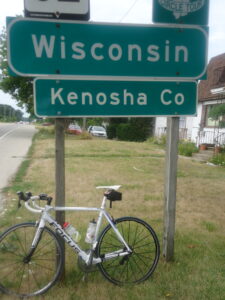
Well, this served as one of my milestones and gave me a little encouragement that I might be able to pull off the secondary goal – 200+ miles if I rode all the way home. I stopped at a Subway close to the WI boarder (really wanted to eat cheese curds at Culvers, but figured it would make me sick) and had me some dinner and a quick 20 minute rest. With the exception of breakfast and lunch, most of what I ate that day was “junk food” whose purpose was simply to give me the most calories for what I could carry on the bike. Thus, it felt really good to eat some real food before heading home.
The ride home was slow, painful and involved me really considering hopping the first train back to the city that I could find. I probably stopped at least 4 times over the 59 mile route, but after the last one (which was just 7 miles from my house) and a text from a teammate who was checking in on me (thanks Diddy), I found the wherewithal to power home and get ‘er done.
So what was the final tally of this insane ride? Let’s see:
- 4 states covered
- 15+ townships/cities visited
- 214 miles ridden in 12 hours 18 minutes
- 7,179 calories burned
- 8 liters of fluid (Gatorade included), 3 honey buns, 1 powerbar, 1 pack of cakesters, 1 lbs of orzo pasta, 1 subway veggie sandwich, and 2 fruit pies all consumed post breakfast
- One mega suntan
- Zero flats!
All in all, I was very happy to pull this ride off. It wasn’t easy by any measure, but then again, that was part of the reason I did it. A part of me gets a great deal of satisfaction of pushing myself into new realms. What some may consider insane is what I consider proving that you can do whatever you want in this world, so long as you put your mind to it. Would I do this ride again? Yes (I can’t say that I felt this way immediately upon finishing) but it will probably be quite some time from now.
If you’ve ever seen my helmet after a ride, you’ll affirm that the straps are usually covered in salt. This last pic doesn’t do my jersey justice, but let’s just say that salt was fully embedded into every fabric of it’s being.

And lastly to Eric – Kyle says that you would have thought I was crazy for doing such a ride. But then again, he said you would have been right there along side me pushing me on. Well, I hope I made you proud sir and thanks for the inspiration!
Health & Finances
Q: I have a small child and over the past few years my employer has really increased the amount their employees pay towards their health care cost. It’s getting to the point that it’s making my finances tight. Is there anything I can do to save on health care cost or should I just look for an employer with better health care benefits?
A: Medical cost can certainly put a pinch on your finances. However, there are several actions that you can take to try to keep things in line. The following are a few ideas to help you survive these rocky times:
Participate in a Flexible Spending Account. A flexible spending account (FSA) is a tax-advantaged savings account set up through one’s employer. It allows an employee to deduct an amount per family from their paycheck pre-tax and then spend it on qualified medical expenses. By deducting the money pre-tax, it is not subject to payroll tax, thus decreasing the amount of tax one has to pay on their income. This could reduce your income tax bill come tax time and result in a greater refund. The drawback to FSA’s is that the money must be spent within the plan year. Any money left unspent at the end of the year is forfeited; this is known as the “use it or lose it” provision.
Prior to the enactment of the Patient Protection and Affordable Care Act, the Internal Revenue Service permitted employers to enact any maximum annual election for their employees. The Act amended Section 125 such that FSAs may not allow employees to choose an annual election in excess of a limit determined by the IRS. The annual limit will be $2,500 for the first plan year beginning after December 31, 2012.
Review your coverage options. HMO or PPO? Premier level or standard level of coverage? Higher deductible or lower one? All of these questions should be reviewed annually to ensure that your health care coverage properly aligns with your current health status and budget. If you know you’re health is failing in a particular year you may want to contribute to a FSA, go with a PPO and pay the lower deductible for the next year if you foresee your problem continuing. In relatively good health and only plan on seeing the doctor for your annual physical? Increase the deductible, only fund the FSA with the cost of that visit and watch your health care cost fall that year. While these are condensed versions of what can be done, the benefits specialist of your HR department can help you review your options and make an accurate decision.
Get those routine check ups. When we’re younger, we often “hope” that whatever is wrong with us will just magically fix itself. Bad idea when it comes to your health as time may be of the essence when it comes to certain ailments. Ignoring a problem will not typically make it better; in fact it will almost always have the opposite effect. For example, Mr. Rogers often recants how he didn’t recall seeing a dentist any of the four years while he was away in college. Result? Two root canals, several treatments for periodontal disease, several “new” cavities and broken fillings and about $4,000 in dental cost that mostly had to be paid out of pocket because he exceeded the annual plan coverage amount. Thus, make it a point to go to the doctor/dentist at least annually and get your check up, as preventative maintenance is much less costly then fixing a major problem.
Live a healthy lifestyle. Healthy eating decisions, routine exercise and living a balanced life can help to significantly reduce health cost, stress and your overall living expenses. For example, “brown bagging it” for lunch can reduce your monthly budget and put you in control of healthier eating options. Mc Chicken sandwich or homemade tuna sandwich with a teaspoon of salad dressing and some relish? Cost wise they are about the same but the tuna sandwich is lower in sodium, fat and calories. Walking the last few blocks to the job versus taking the bus can reduce your weight and increase the efficiency of your cardio vascular system, which can in turn reduce stress and high blood pressure.
All of the above, when combine with the previous three options, can lead to decreased health care cost, less frequent doctors visits and a better state of health in general. But if your employer keeps raising cost at an unbearable rate, you might have to take these tactics to a new employer with better benefits and coverage.

Click above to watch our Money Management and Tax Chit Chat video series!

Click Above For Your Top Secret Guide To Tax Reduction, Business Success and Solving IRS Debt Problems!

Click Above To Learn 111 Ways To Slash Your Tax Bill!