
Home Office Tax Deduction Requirements

If you use part of your home for business, the IRS will generally allow you to deduct certain expenses come tax time. The home office deduction is available for homeowners AND renters, and applies to all types of homes. In order to take the deduction, there are two basic requirements that you must satisfy:
Regular and Exclusive Use
You must “regularly” use part of your home “exclusively” for conducting business. For example, if you use an extra room to run your business, you can take a home office deduction for that extra room. The exclusive portion of the equation usually means that you can’t use that room for other things. Meaning, if the room is your den and you also use it for entertainment or other social activities, then the deduction will not be allowed. Also, if the room or space isn’t used on a regular basis (i.e. you only have business meetings in that room once a quarter), the deduction will also not be allowed.
Principal Place of Your Business
In addition to the above, you must show that you use your home as your principal place of business. If you conduct business at a location outside of your home, but also use your home substantially and regularly to conduct business, you may qualify for a home office deduction. For example, if you have in-person meetings with patients, clients, or customers in your home, even though you also carry on business at another location, you can deduct your expenses for the part of your home used exclusively and regularly for business. You can deduct expenses for a separate free-standing structure, such as a studio, garage, or barn, if you use it exclusively and regularly for your business.
How to claim the deduction
Generally, deductions for a home office are based on the percentage of your home devoted to business use. Thus, if you use whole or part of a room for conducting your business, you will generally need to figure out the percentage of your home devoted to your business activities. However, note that there are TWO methods for you to determine the deduction:
Simplified Method
For taxable years that started on or after, January 1, 2013 (filed beginning in 2014), taxpayers have the option of using the simple method per IRS Revenue Procedure 2013-13. The standard method (discussed next) has some calculation, allocation, and substantiation requirements that some consider complex and burdensome for small business owners. The simplified option can significantly reduce the recordkeeping burden by allowing a qualified taxpayer to multiply a prescribed rate by the allowable square footage of the office. In most cases, the deduction is calculated by multiplying $5, the prescribed rate, by the area of your home used for a qualified business use. However, note that the area you use to figure your deduction is limited to 300 square feet. So if your office is larger than this number, you may want to take the time to use the next method.
Regular Method
Taxpayers who use the regular method (required for tax years 2012 and prior), must determine the actual expenses associated with their home office. These expenses may include mortgage interest, insurance, utilities, repairs, and depreciation. Once the amount spent on each category is determined, one must then allocate them between the space used in connection with their business and the rest of the dwelling. To do this, one will use IRS Form 8829.
Where to deduct
Where you take the deduction on your tax return depends on how you conduct your business:
- If you are self-employed: report the entire deduction on line 30 of Schedule C (Form 1040). Whether you need to complete and attach Form 8829 to your return depends on which method you used above to perform your calculation.
- If you are an employee: you must itemize deductions on Schedule A (Form 1040) to claim the deduction, generally on line 21 (unreimbursed employee business expenses).
- If you are a member of a partnership, multimemeber LLC or S-Corp: take a look at this post for more information on how to claim the deduction.
To learn more about the following, we suggest that you take a look at IRS Publication 587:
- Types of expenses you can deduct.
- How to figure the deduction (including depreciation of your home).
- Special rules for daycare providers.
- Tax implications of selling a home that was used partly for business.
- Records you should keep
What moving expenses can you deduct?
Over the past year or so we’ve had a few of our clients move to another state. In addition to knowing if their new city imposes an income tax the next question usually is “What moving expenses can I deduct?” The answer is really a two part matter of can I deduct my moving expenses AND what expenses can be deducted.
Who can deduct moving expenses? In order to deduct your moving expenses, you must meet the following three requirements:
- Your move must be closely related, both in time and in place, to the start of work at your new job location.
- Time: Moving expenses incurred within 1 year from the date you first reported to work at the new location can “generally” be considered closely related in time to the start of work.
- Place: If the distance from your new home to the new job location is not more than the distance from your former home to the new job location, you can “generally” consider yourself as satisfying this test.
- You must meet the distance test. Your move will meet the distance test if your new main job location is at least 50 miles farther from your former home than your old main job location was from your former home. See the illustration below for an example.
- You must meet the time test. If you are an employee, you must work full time for at least 39 weeks during the first 12 months after you arrive in the general area of your new job location (39-week test). If you are self-employed, you must meet the above AND work a total of at least 78 weeks during the first 24 months after you arrive in the general area of your new job location (78-week test).
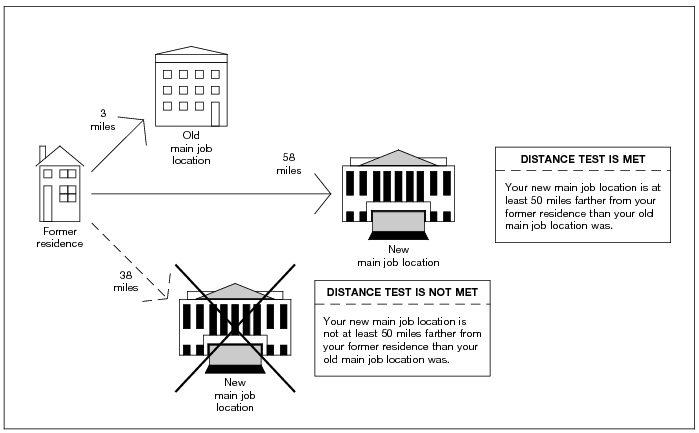
What moving expenses can be deducted? Once you determine that you qualify to deduct your expenses, you should keep track of the cost related to the following (which are deducted on IRS Form 3903):
- Moving your household goods and personal effects (including in-transit or foreign-move storage expenses), and
- Traveling (including lodging but not meals) to your new home.
Moving household goods and personal effects. You can deduct the cost of packing, crating, and transporting your household goods and personal effects and those of the members of your household from your former home to your new home. For purposes of moving expenses, the term “personal effects” includes, but is not limited to, movable personal property that the taxpayer owns and frequently uses.
Travel expenses. You can deduct the cost of transportation and lodging for yourself and members of your household while traveling from your former home to your new home. This includes expenses for the day you arrive.
If you use your car to take yourself, members of your household, or your personal effects to your new home, you can figure your expenses by deducting either:
- Your actual expenses, such as the amount you pay for gas and oil for your car, if you keep an accurate record of each expense, or
- The standard mileage rate per the IRS for the tax year of the move (as it is indexed annually)
Nondeductible expenses. The following expenses are not deductible:
- Pre-move househunting expenses
- Return trips to your former residence
- Any part of the purchase price of your new home
- Expenses of buying or selling a home (including closing costs, mortgage fees, and points)
- Expenses of entering into or breaking a lease
- Home improvements to help sell your home
- Loss on the sale of your home
- Mortgage penalties
- Real estate taxes
- Security deposits (including any given up due to the move)
- Storage charges (except those incurred in transit and for foreign moves)
- Car tags
- Driver’s license
If you need more information feel free to give our office a call, shoot us an email via the address in the footer or check out IRS Publication 521.
10 Ways To Get Word Of Mouth Marketing
It’s not uncommon for us to get new bookkeeping clients who are relatively “new” in their business endeavors. When we discuss their business and needs, we will often ask “What are you doing from a marketing perspective?” When “word of mouth marketing” is their response, we often feel compelled to have a teaching moment with them.
Word of mouth marketing is not a marketing vehicle in and of itself. It is the direct result of doing other tasks well within your business, one of which is other marketing. This post highlights 50 ways that you can market your small business. Shown here are the things that will help you generate that word of mouth buzz that so many businesses crave:
Provide an excellent product or service. If what you have to offer is just average, or even worse undesirable, don’t expect customers to extol your virtues. What you sell and how you sell it, should live up to or exceed what your customers expect. This is based on your ads, sales pitch and industry standards. If they’re happy with what they’ve bought, they will sing your praises to the heavens. Yet remember, word of mouth works two ways. If customers are unhappy with your company, they will complain loudly and publicly about their bad experience. Don’t believe us? Just look at this post about a poor customer service experience we had. Which leads us to our next point…
Excel in your customer service. This post will give you several ways to be better than your competition, so we urge you to read it. Yet a few basics to know: Be polite. Answer your customers questions as accurately and quickly as possible. Don’t keep them waiting unnecessarily. If you can do something for a customer, then do it. If you can’t, tell them so and send them to someone who can (even a competitor). By helping your customer solve their needs, they will remember you and send your their friends and family when they have a similar problem.
Give your customers something for FREE. People have needs that require solutions. When they look for those solutions, they will go to the internet, call their friends or even visit your establishment. However, there’s so much noise in the world that it’s hard for prospects to know exactly what’s worth buying. Most people buy stuff that they have a personal connection with or that is recommended by a trusted friend. By giving away your work (or a sample of it) you allow future customers (or readers or fans or whatever) the opportunity to hear about it, see the value in it, and then reward you for it.
Thank your customers for their business. Everyone likes to be appreciated and customers are no exception. When a customers pays you for services or a new customer signs their paperwork, why not send them a handwritten thank you card? Doing something your competitors don’t will set you apart as a business who cares about their customers and is worth recommending.
Make you and your employees “likable” in their interactions. We’ve said it before and we’ll say it again, customers do business with those who they know, like and trust. As such, make sure that when you interact with your customers, that they like dealing with you. Be friendly; no matter how rude or angry a customer may be. Never raise your voice, be sarcastic, or speak in a demeaning way to customers. Smile when you speak to them. Take a genuine interest in their needs, concerns and wants. When a customer likes dealing with you, they will like sending others to you.
Be personally visible to your market. The goal here is to not be viewed as a salesperson, but as a friend or problem-solver. If you take the information regarding providing “free” stuff and combine it with this point, you will be seen as just that. As such, join networking groups and industry groups that your customers join and be a regular attendee at meetings and events. Talk to people at meetings to find out what they do and what’s important to them and what challenges they face. When you can, give them tips or point them to resources they need, even if it isn’t a service that you offer.
Be Active in Social Media. A social media “share” spreads the word about your company to all the people who follow and like your information. While you don’t need to set up an account on each, Facebook, Twitter, Linked, Pinterest, Instagram and SlideShare are all good places to start. Choose the social media channels that are most likely to reach your target customers. Also, the easier you make it for customers and prospects to share your information and promotions, the more likely it is they will do so. As such, consider adding the corresponding social media buttons to your website.
When people praise you, ask to use their testimonial. You can post it on your website and/or in promotional material. Their comments can help prospects “hear” good things about your company. This is exactly why we have a testimonials page!
Make your business easy to find. Start by having a website, even if it is just a simple landing page. Make sure that it is listed on Google, Bing and Yahoo’s business promotion sites. If you have a location, make sure that you have singe indicating what you do, hours of operation and phone number. If you have vehicles, make sure your name is painted/wrapped in big letters on them so anyone who sees it knows how to reach you. Leave “extra” business cards with customers so they can hand them out when a neighbor asks if they were happy with the job you did… and how to get in touch with you.
Refer business to noncompeting businesses. When you refer customers, patients or clients to others, those businesses are more likely to refer business to you. Remember, those who give freely of themselves will receive the same in return.
Reward those who refer business to you. How you thank them will depend on the nature and what is considered ethical in your line of your business. It may be in the form of a hand-written thank you card, a coupon, a cash reward, or whatever else is practical or expected for your line of work. But the point is this; rewarding those who help you will make them feel their efforts are appreciated, which will make them be glad to recommend you to more people.
Top Small Business Marketing Mistakes
Recently we were having lunch at Columbus’ Curry, a new quick dining establishment specializing in Indian cuisine. During this visit, we had the fortunate opportunity to meet the owner. Turns out that they had only been open for four weeks, but they indicated that things were going well thus far. At some point, our conversation turned to what the “most important” thing to focus on should be. Our response? Generating sales!
As we’ve said in previous posts, nothing happens in an organization until a sale is made and sales don’
No marketing plan. Failure to plan is like planning to fail – we’ve all heard that statement correct? Well, if you don’t have a marketing plan, then you can rest assured that your marketing will not be is effective as it needs to be. People often think that a marketing plan needs to be this overly complicated document that takes months to develop. That is not the case. A simple marketing plan can be made in short order. Take a look at this article to see just how to put one together and what it should contain.
No marketing budget. Equally egregious as not having a marketing plan, is not having a marketing budget. When you start a business you may be consumed in pouring all of your dollars into research and development, product engineering, hiring staff or outfitting your headquarters. However, if you don’t have the budget to tell your target market about your product or services, how will they find you? “Oh, if we build it they will come” is your response? Read the next bullet dear friend.
Having a “build it and they will come” mentality. We’ve written about this before in our Small Business Marketing 101 post. The key takeaway from it is that even with a highly visible location it’s EXTREMELY hard for potential customers to “see” you. The only way to ensure that the do, is to market to them. Furthermore, even if they know you are there, what is going to make them choose you over your competitors? For that, we recommend that you emphasize your Unique Selling Proposition or USP in all of your marketing collateral.
Failing to “test” your marketing. Marketing should never be viewed as a “one and done” type of activity. The one thing that is constant in the world is change. Thus, you must frequently look at your marketing activities, vehicles, collateral, etc. and make sure that it is working. If it isn’t, then you need to make adjustments to it. If you do a mailing and you get a 2% response rate, test doing a similar mailing but tweek the headline, body, mailing list, etc to see if the results change. Keep “testing” various elements of the campaign until you get the desired result. All of this leads us to the next point.
Not holding your marketing accountable. If you are involved in various marketing activities, you should always hold your marketing ruthlessly accountable for revenue. One of the first things we ask customers is how they heard of us. Why? We want to know which vehicle brought them to us. We then track various metrics associated with this such as number of leads, leads converted to customers, revenue spent per customer, cost of client acquisition, etc. If we don’t see the return on investment for a particular vehicle we either 1) test it, 2) change it or 3) abandon it. If we get to the third, that allows us to shift those dollars to something that IS producing desired results. The worst thing you can do is continue to pour money into something that is not generating sales.
Trying to reinvent the “Marketing” wheel. Marketing is not hard stuff (in simplistic terms of course). Yes, there is the need to reinvent and refresh your marketing so that it remains relevant and in sync with the times, but you don’t have to go back to the drawing board to make it yours. In this post, we talk about 50 ways that you can market your small business. The point? You don’t have to start from scratch; look at the items, choose what works for you and then make it fit your business.
Continuous planning without execution. The fear of failure is a very powerful thing. In this post, our CEO Jared Rogers talks about getting over his fears when he struck out to head the Beverly office. In the end he got over them and started doing things. The point is that you can be so busy preparing, organizing, and researching your marketing to prevent failure that you never get around to the actual marketing. To combat this remember:
- Activity is not productivity.
- In order to sell a million of something, you have to sell the first ONE.
At some point you have to start your marketing and just see what happens. Remember, mistakes are the price of entry into the world of success. A failed promotion means you have SUCCESSFULLY determined what does NOT work; and that is a invaluable tool in getting you closer to discovering what DOES work.
Avoiding 401(k) Early Withdrawal Penalties
The point of investing in a 401(k) plan is to build your savings for retirement. Generally, if an individual withdraws from their 401(k) plan before reaching age 59½ they are taking what are called ”early” or ”premature” distributions. As such, individuals must pay an additional 10% early withdrawal tax, unless an exception applies, AND include the amount of the distribution in their income when they file their income tax return.
Sometimes you have no choice and are forced to tap into your account. Here are some ways that you can make withdrawals and avoid getting hit with penalties for doing so.
Age – Begin after age 59½ once you leave your employment (at any age).
Separation From Service – Begin after you separate from service during or after the year you reach age 55 (age 50 for public safety employees in a governmental defined benefit plan).
High Unreimbursed Medical Expenses – If you, your spouse, or your qualified dependent face these expenses, you may be allowed to withdraw a limited amount (the actual expenses minus 10% of your AGI) without penalty.
Death – If you die, your beneficiaries are able to take distributions from your 401k without penalty.
Disability – If you are “totally and permanently disabled” by IRS definition, you may be able to take distributions from your 401k without penalty.
Series Of Substantially Equal Periodic Payments – Essentially you agree to continue taking the same amount from your plan for the greater of five years or until you reach age 59½. There are three methods of doing this:
- Required Minimum Distribution method – This uses the IRS RMD table to determine your Equal Payments.
- Fixed Amortization method – Under this method, you calculate your Equal Payment based on one of three life expectancy tables published by the IRS.
- Fixed Annuitization method – This uses an annuitization factor published by the IRS to determine your Equal Payments.
IRC Section 72(t) provides additional methods for taking a distribution from your 401k which can occur before leaving employment (if the plan allows). However, note that the following are NOT applicable to a 401(k), but DO apply to an IRA withdrawal:
- Qualified higher education expenses
- Qualified first-time homebuyers, up to $10,000
- Health insurance premiums paid while unemployed
So if you are considering using your 401(k) funds for any of the above, you might want to make a “trustee-to-trustee” transfer to an IRA account first and then take the distribution from that account.

Click above to watch our Money Management and Tax Chit Chat video series!

Click Above For Your Top Secret Guide To Tax Reduction, Business Success and Solving IRS Debt Problems!

Click Above To Learn 111 Ways To Slash Your Tax Bill!